
What
HFT trading software is a purpose-built system that submits, cancels and fills orders in microseconds or nanoseconds, holds positions for milliseconds to seconds, and earns a fraction of a tick per trade across millions of trades a day. It is not a program you install. It is a data-center deployment: proprietary code, often on FPGA hardware, physically located inside the exchange’s building and connected by dedicated fiber and microwave links.
The execution speed gap
What it does, in numbers
Order rate: a leading system places and cancels 10,000 or more orders per second.
Holding period: milliseconds to a few seconds. Positions are flat at the end of every day.
Share of the market: an estimated 50% to 60% of U.S. equity volume in 2026, from about 2% of trading firms. More than half of futures volume is algorithmic.
What it trades
Market making: quoting both sides and capturing the spread. About 72% of HFT revenue.
Latency arbitrage: seeing a price change on one venue and trading on another before it updates. Chicago-to-New-Jersey microwave is about 4 milliseconds faster than fiber. That is the whole trade.
Statistical arbitrage: trading the momentary gap between related instruments, for example SPY against ES.
None of these strategies is secret. All of them stop working the moment someone else is faster. That is why the software is inseparable from the infrastructure, and why the infrastructure is the real product.
Who
Roughly ten proprietary firms dominate HFT in 2026: Citadel Securities, Jane Street, Hudson River Trading, Jump Trading, Virtu Financial, XTX Markets, Optiver, IMC, Tower Research Capital and DRW. Most of the firms that competed with them a decade ago have closed or been absorbed.
The survivors’ numbers
Hudson River Trading reported about $6.4 billion in revenue in the first quarter of 2026 with roughly 1,000 employees, up 135% year over year. Jane Street reported about $16.1 billion in the same quarter, up 100%. Annualized, that is $18 million to $25 million of revenue per employee.
The industry that fed them
TABB Group estimated that HFT revenue from U.S. equities peaked at $7.2 billion in 2009 and fell below $1 billion by 2017, an 85% decline while the leaders kept growing. IBISWorld puts the U.S. HFT industry at $6.1 billion in 2025, shrinking at a 0.8% compound rate since 2020. The pie stopped growing; the leaders took a larger share of it.
Who shut down or sold out
Of the 21 HFT firms founded between 2000 and 2010, 13 remain. The firms founded since have almost all been started by veterans of the survivors. Chicago once had several hundred proprietary trading shops. A capital-markets analyst summarized the outcome in 2017: ultra-low latency requires investment beyond the reach of most small and mid-size trading firms, and consolidation would continue. It did.
When
HFT became possible in 1998, peaked in 2009, and closed to new entrants between 2012 and 2018.
The pattern is consistent: each step that made HFT faster also made it more expensive, and each cost increase removed another tier of participants. By the time co-location, FPGAs and microwave were all required, the entry price was in the millions and the incumbents already owned the towers.
Costs, side by side
The left column is the smallest credible HFT operation: two venues, no redundancy, figures as reported by industry sources for 2025–2026. The right column is what the Suite actually costs to run. Both have real advantages; the question is which set of advantages you can afford and can use.
$200,000 to $400,000In-house build, 9 to 15 months before the first live trade. An FPGA feed handler for a single venue is reported at about $5.35 million and 3.5+ years. Doubles with redundancy.
$34,195, once, for a lifetime licenseTrade up to 15 contracts per leg, and scale in up to 3 additional legs, each up to 15 contracts. Need more contracts? Purchase 15-contract lots at only $5,000 each. Most clients are up and running in minutes. The current offer date is posted under each price below.
FPGA cards, low-latency network cards and servers, all inside the co-location cabinet. Refreshed as competitors get faster.
One Windows 10+ 64-bit workstation: 3.0 GHz+ CPU, 24 GB RAM for one instrument or 32 GB for two, 10 GB SSD, wired internet. Hardware you already own or can buy for a few thousand dollars.
$15,000 to $19,000 per monthOne co-location cabinet at CME Aurora, plus a $10,000 deposit. Direct membership and proprietary feeds add about $200,000 up front and $20,000 per month per venue.
Your broker’s connection through NinjaTrader Brokerage or Interactive Brokers. No cabinet, no membership, no deposit.
$5,000 to $50,000+ per monthPer exchange, for raw low-latency feeds.
Standard futures data from your broker at retail rates.
A custom C++ or FPGA stack maintained by your own staff, plus a low-latency institutional news feed priced per seat.
$0 to $99 per monthTrading through NinjaTrader Brokerage, the NinjaTrader 8 platform is included at no charge. Trading through Interactive Brokers requires the NinjaTrader Multi-Broker license at $99 per month. Either way, add your own Google Gemini API key on Google’s pay-as-you-go pricing for PQNews™ 2.0.
Quant developers, FPGA engineers, network engineers and compliance. Software maintenance alone runs 15% to 25% of the build cost every year.
None. Updates, training and support are included for the life of the license.
Several million dollars of clearing collateral before the first trade, on top of trading capital.
The margin your broker requires for the contracts you trade. Nothing else.
Thousands of tiny spread-capture trades a day with almost no directional risk, and exchange rebates for providing liquidity. Revenue rises with volatility and compresses when markets are quiet, while the fixed costs run every month.
A fully automated trading system that runs multiple multivariate LSTM models that compete to pick the top ML model, checks the news via Gemini’s API in real time so trades don’t run counter-trend to news, manages the trade entries, exits, trailing stops (various kinds), stop and profit target, scales additional trades each with their own trailing stops, stops and profit targets, and provides you with several tiers of money management including high-watermark protection. Trades last 30 to 70 minutes, so speed does not decide them.
$800,000 to $1,250,000$200,000 to $400,000 of build plus $600,000 to $850,000 of operating cost, before collateral and trading capital.
$34,195 to about $35,000The license, plus $1,188 of NinjaTrader fees only if you trade through Interactive Brokers, plus Gemini API usage and broker data.
$600,000 to $850,000Co-location, data, staff and maintenance, whether or not the year is volatile enough to pay for them.
$0 to about $1,188Nothing for the Suite. $1,188 a year for the NinjaTrader license only if you trade through Interactive Brokers, plus Gemini API usage and broker data.
The difference: roughly $766,000 to $1,218,000 in year one, and $599,000 to $850,000 every year after, before the several million dollars of clearing collateral an HFT firm must post. That money stays in your trading account instead.
HFT figures are as reported by industry sources for 2025–2026 and are approximate; exchanges and vendors do not publish uniform price lists. Suite figures are the current license price and the NinjaTrader Multi-Broker fee that applies when trading through Interactive Brokers; Gemini API and broker data charges depend on usage and provider.
Hypothetical performance
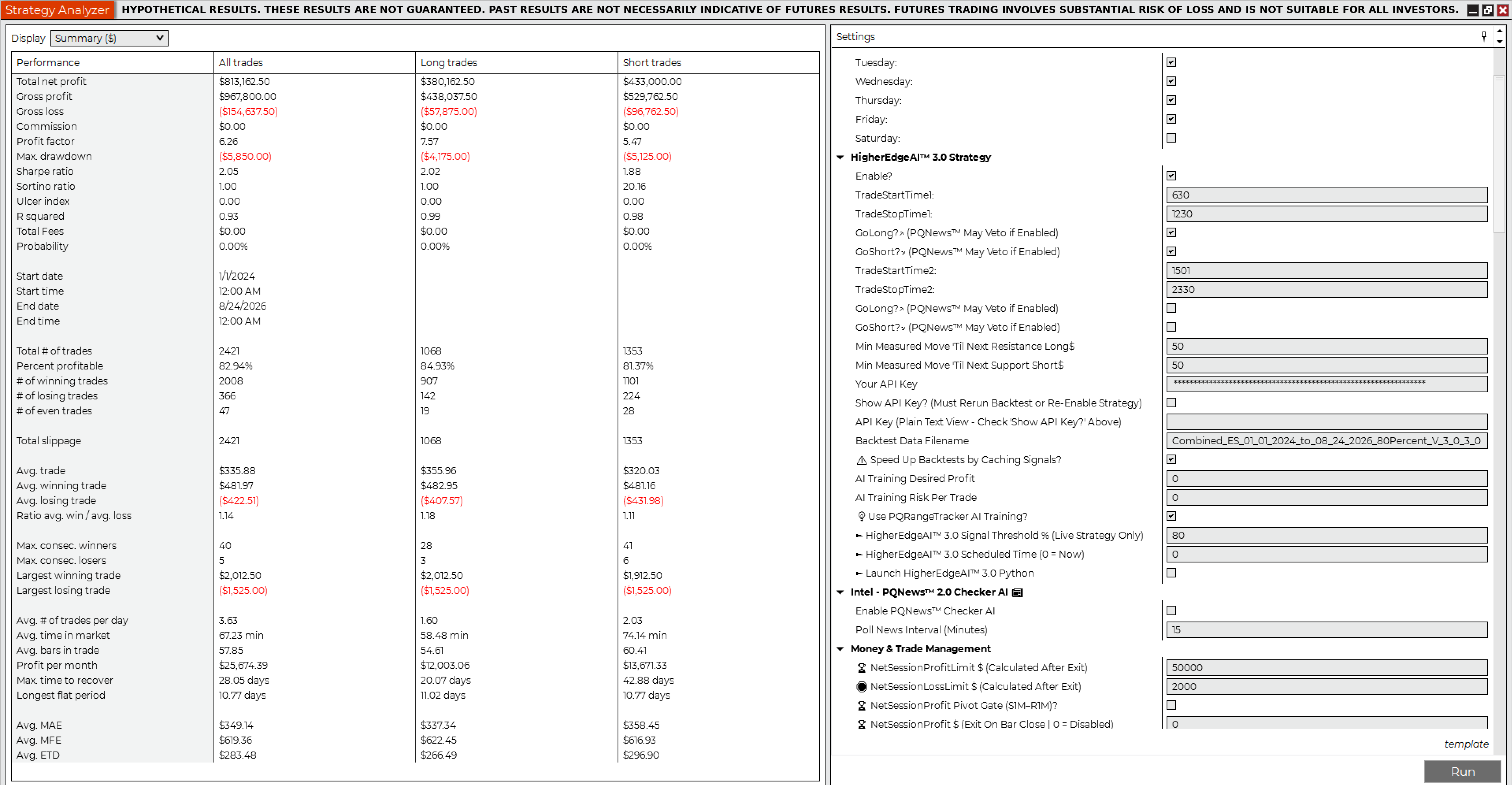
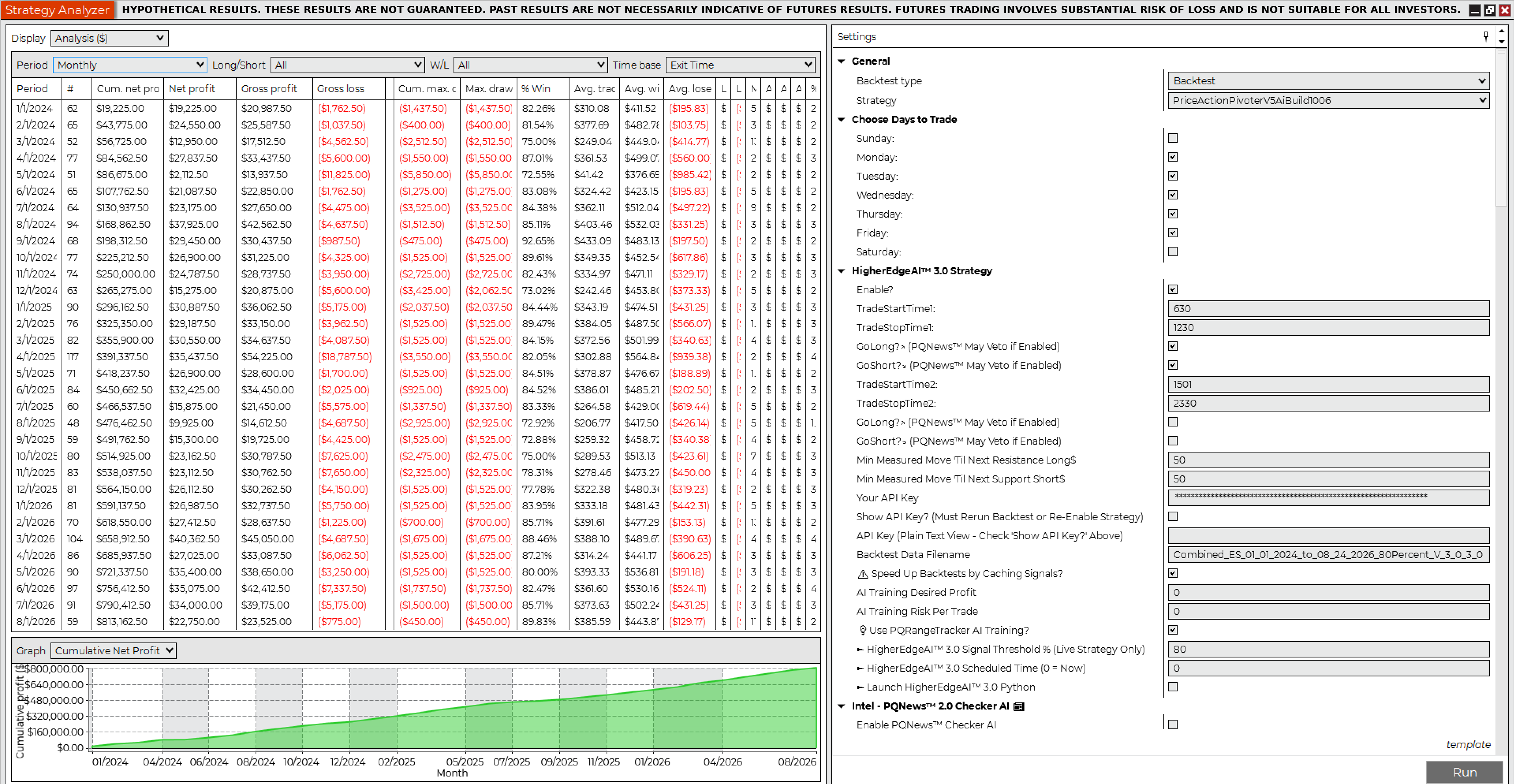
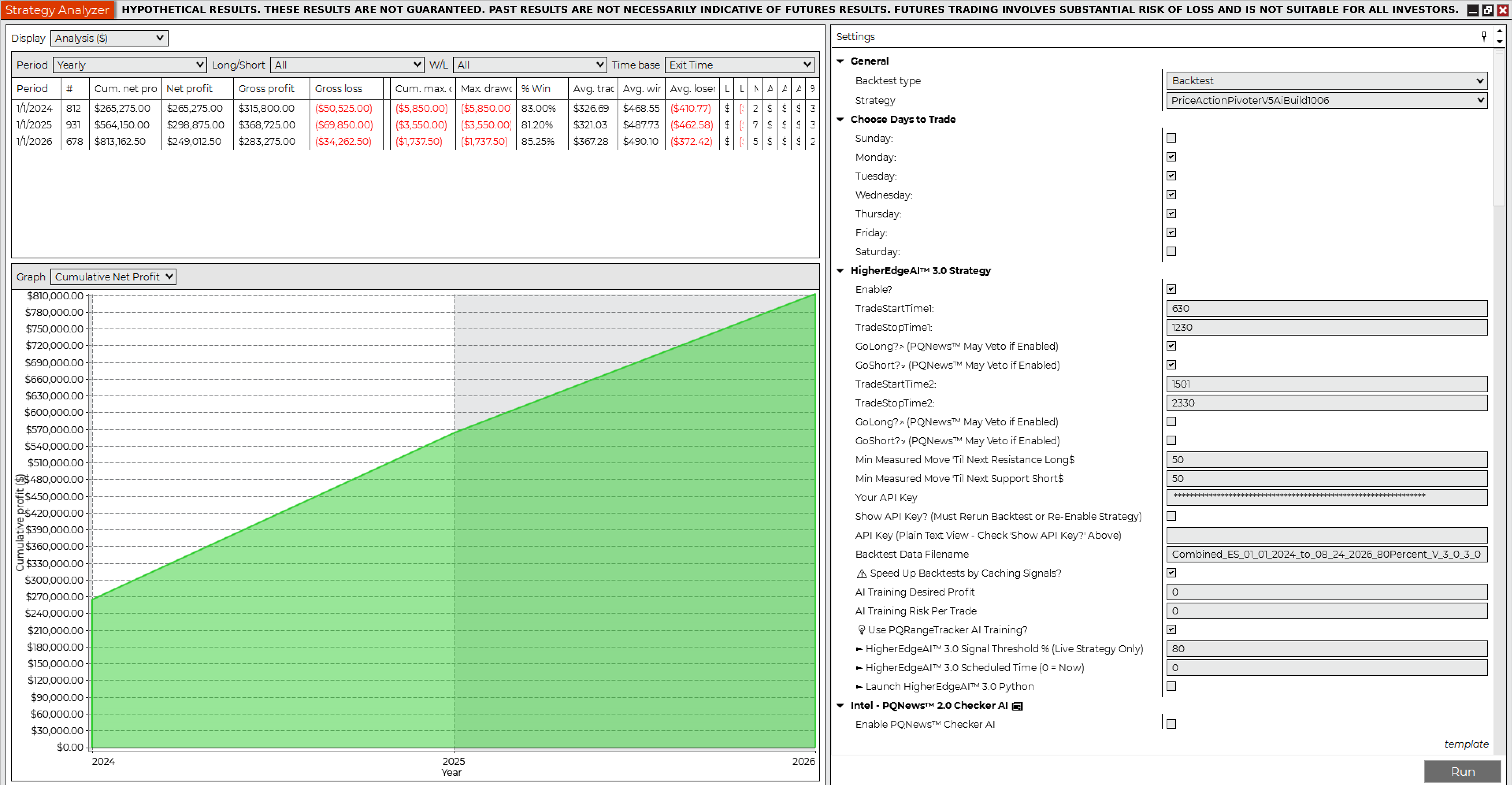
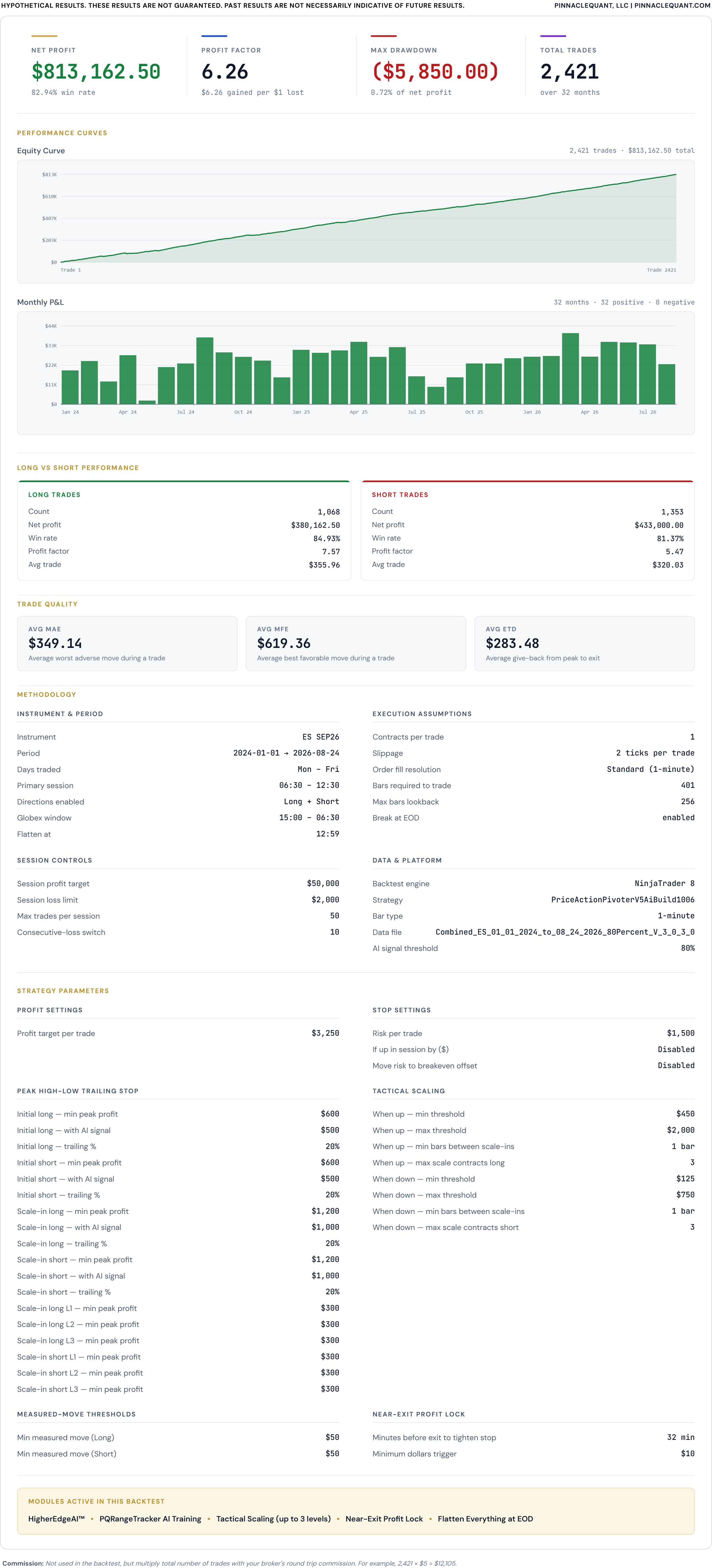
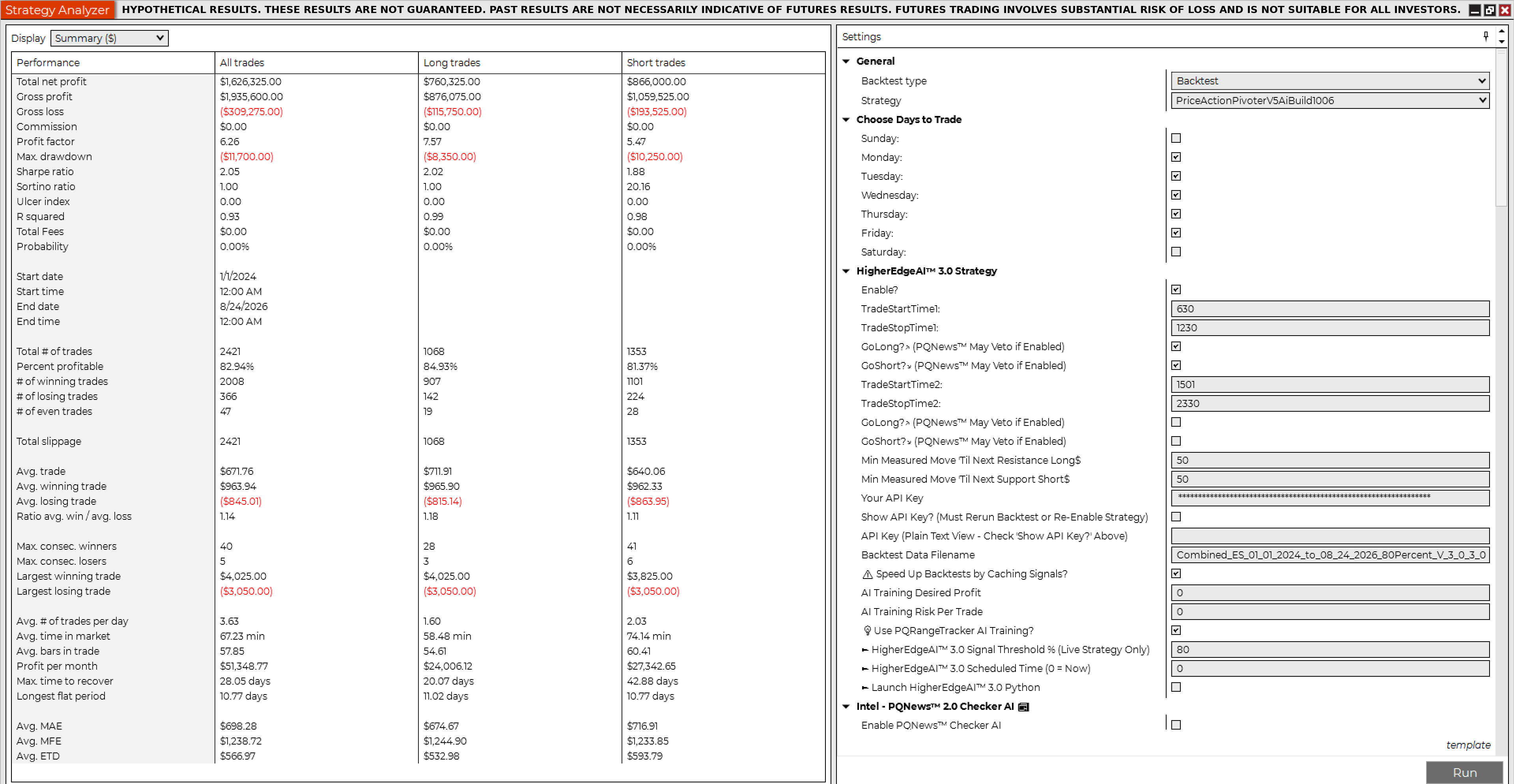
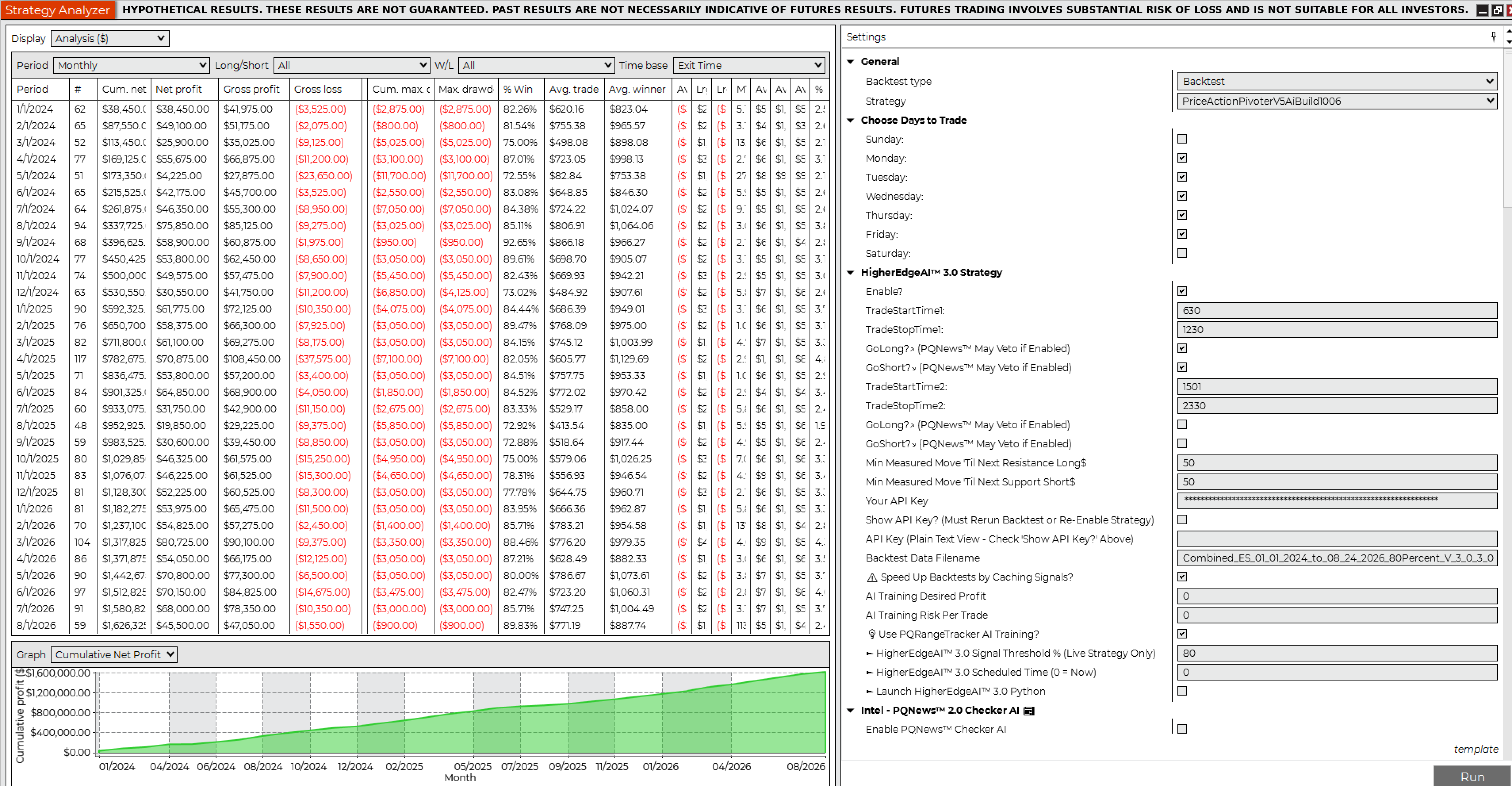
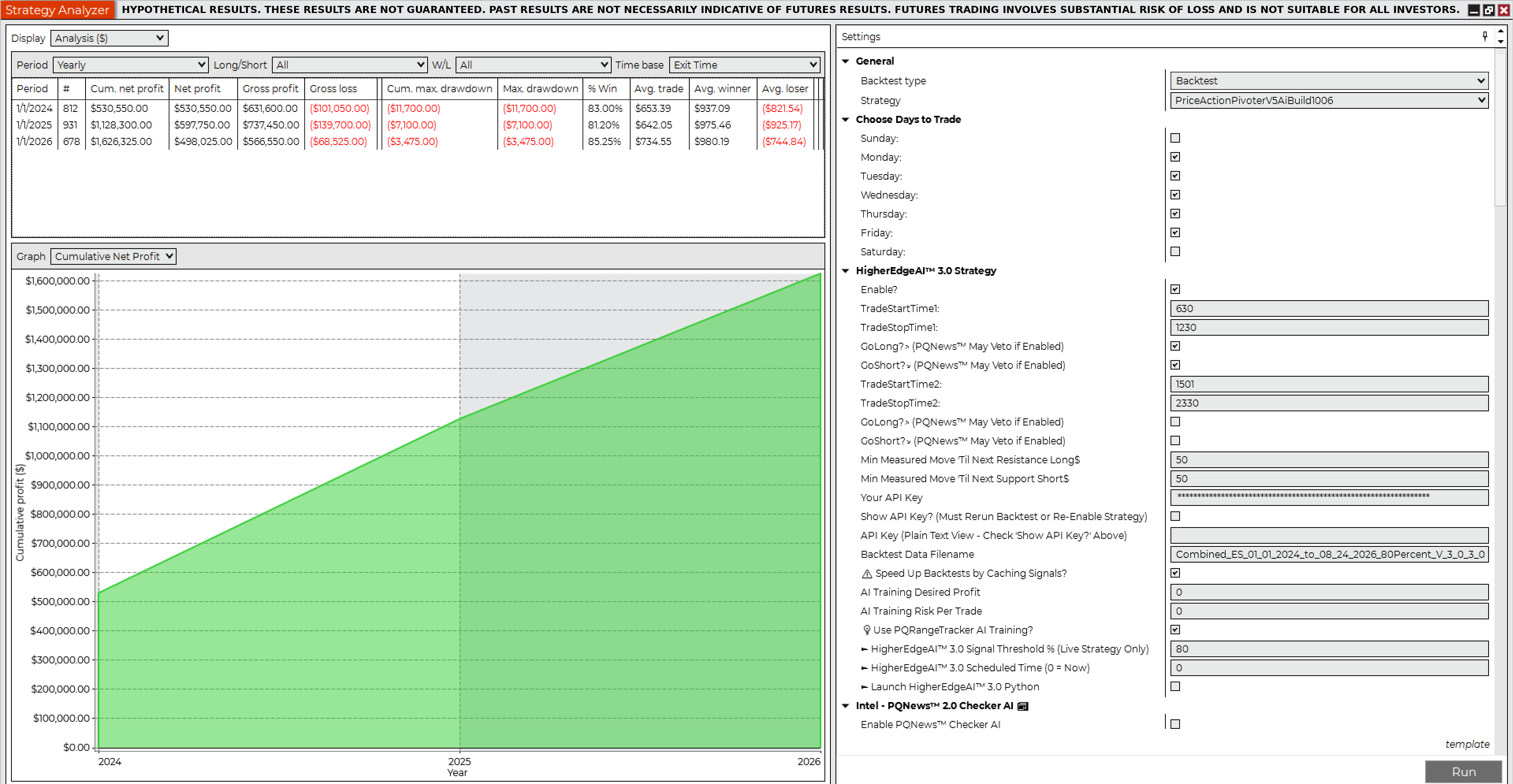
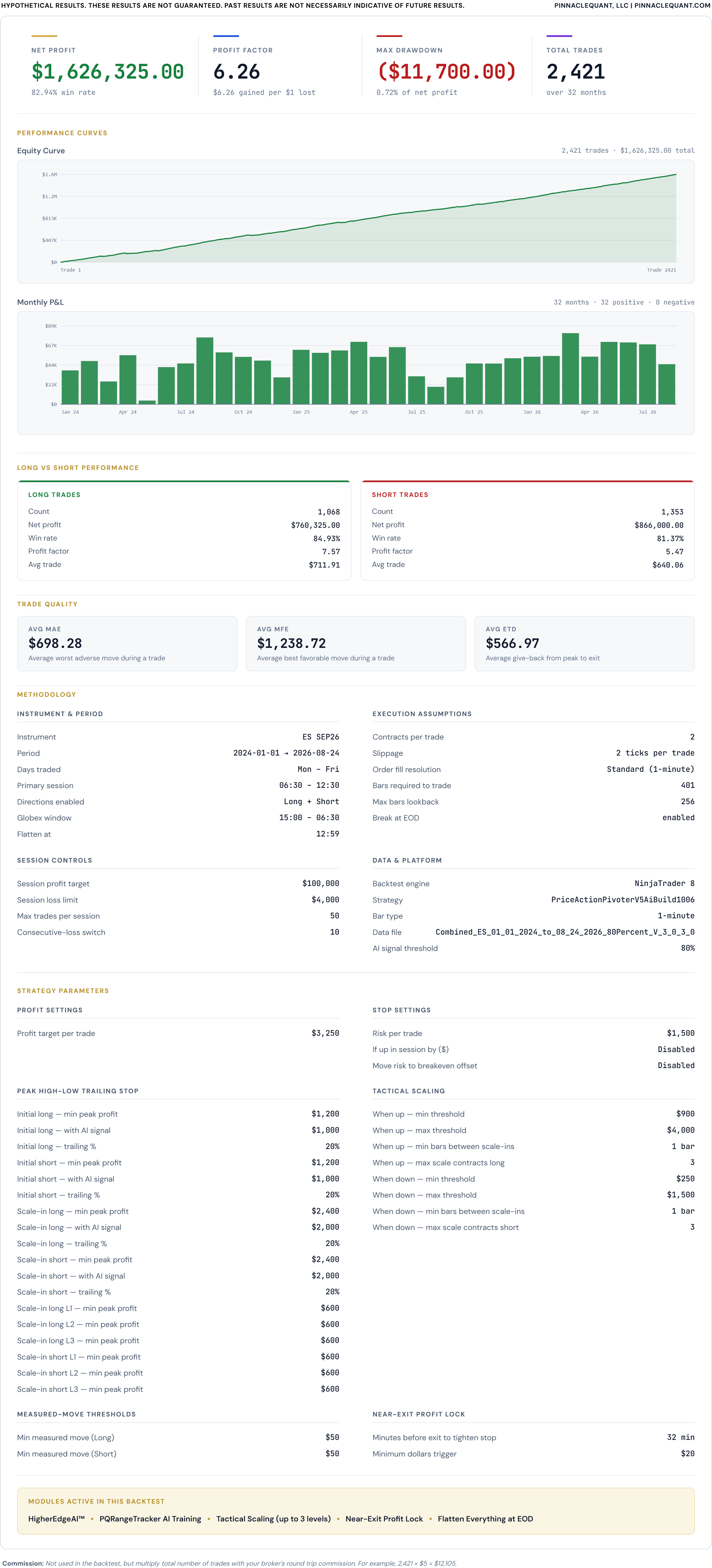
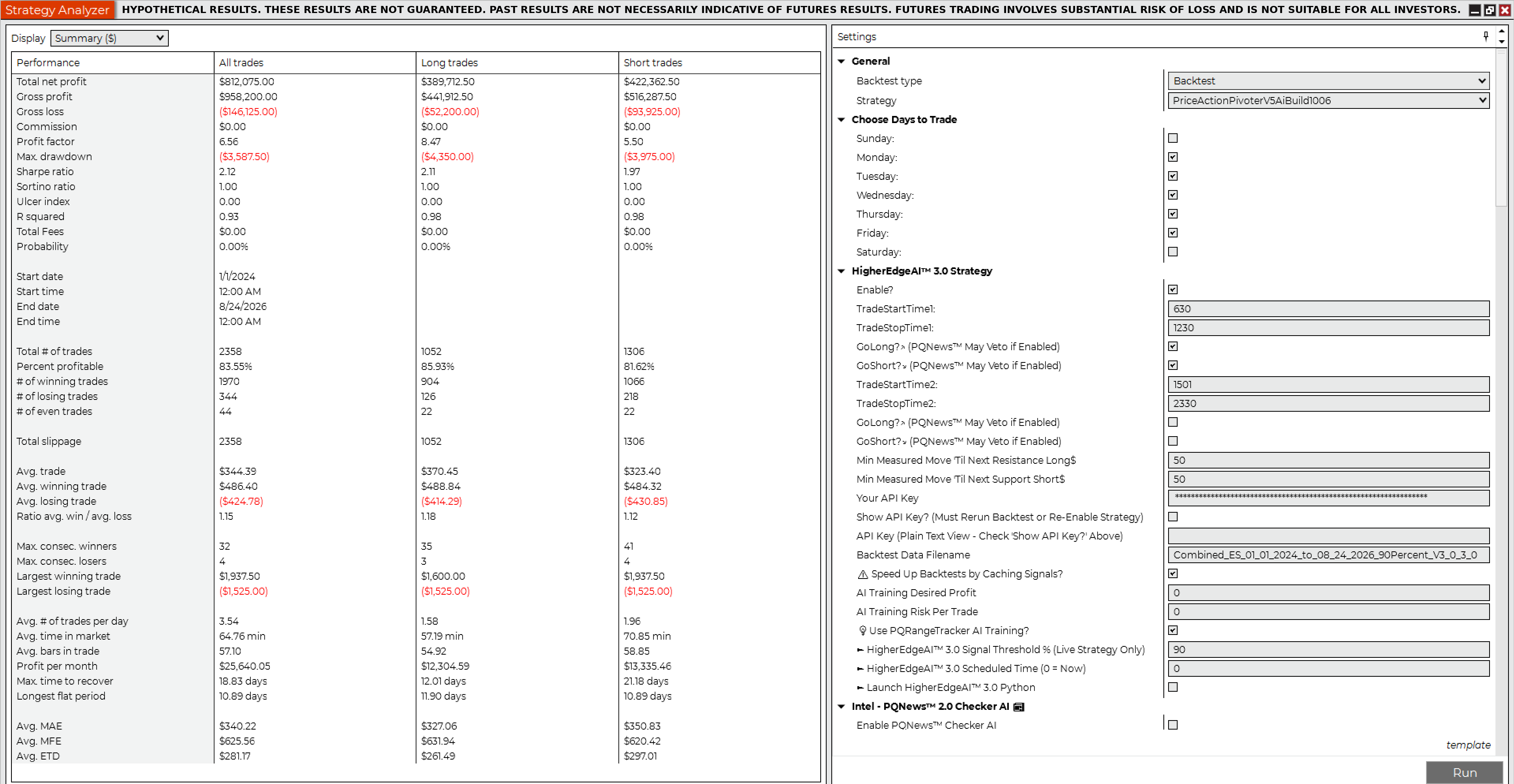
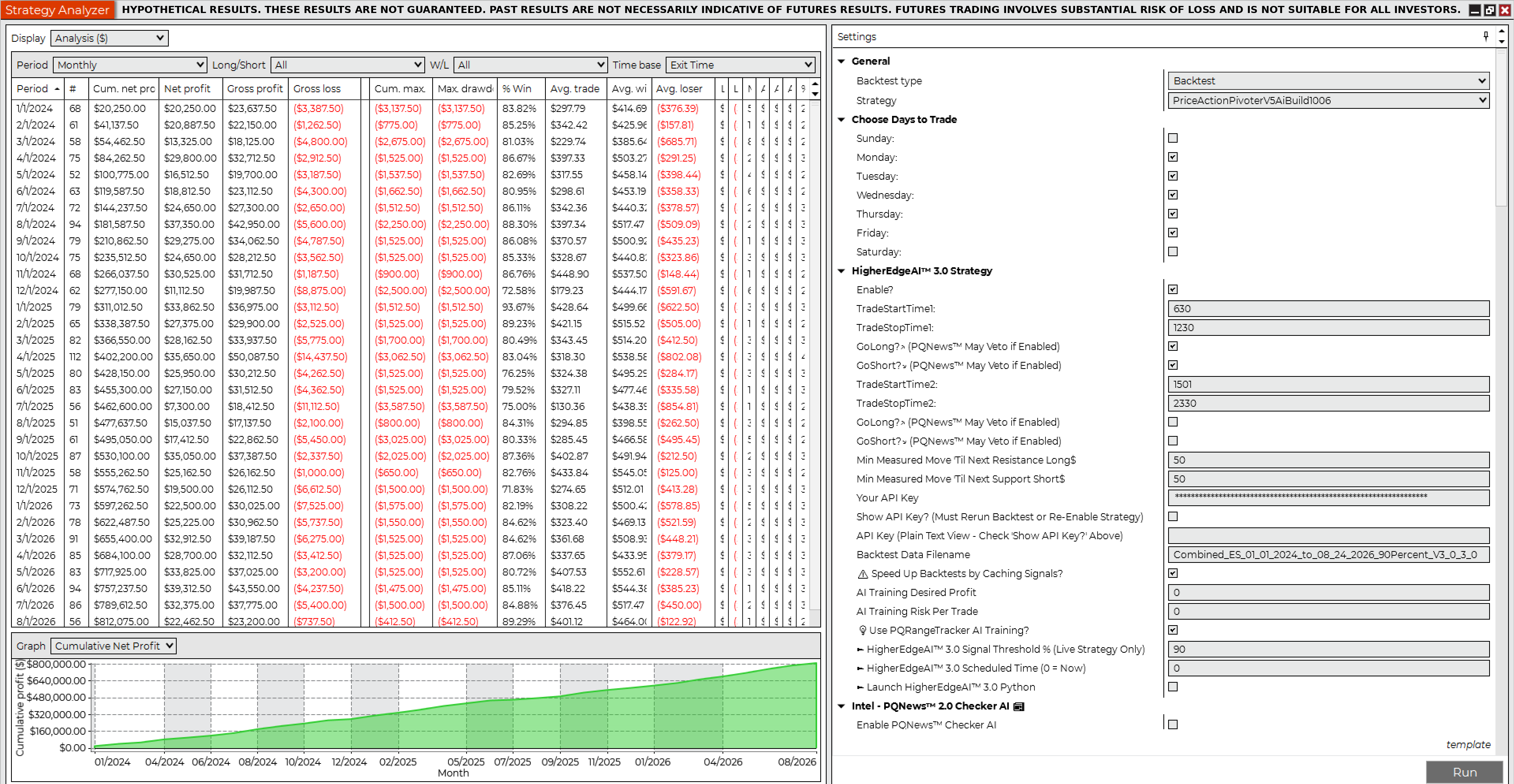
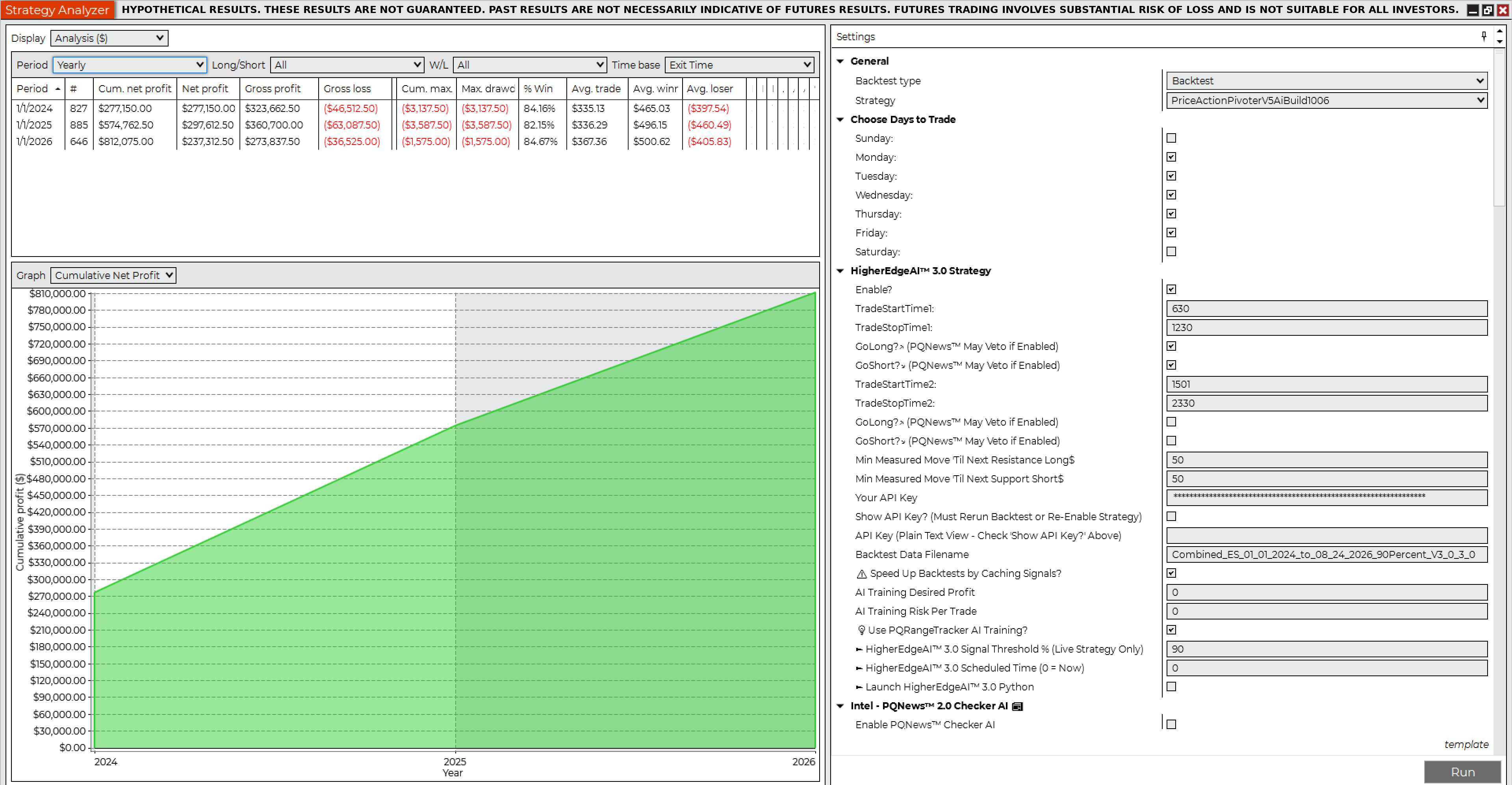
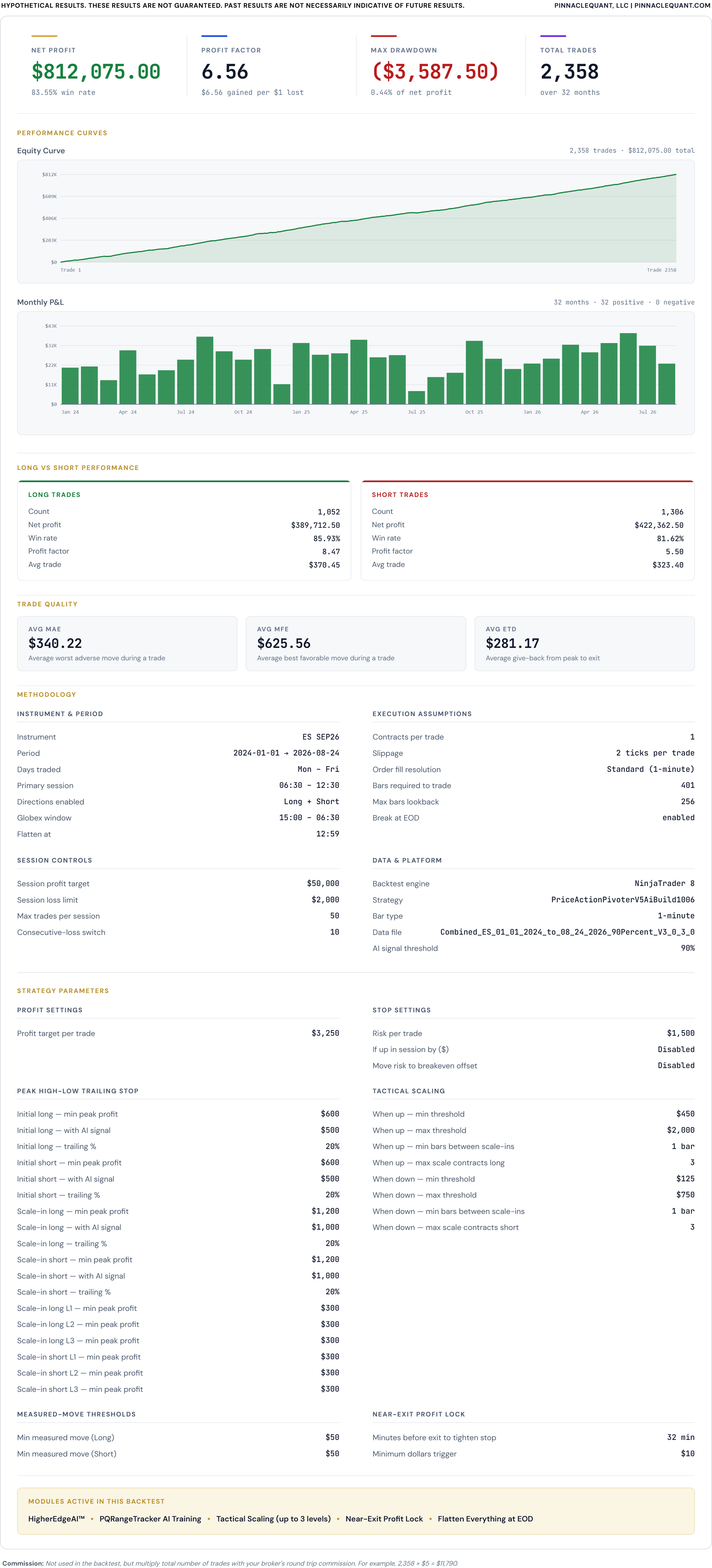
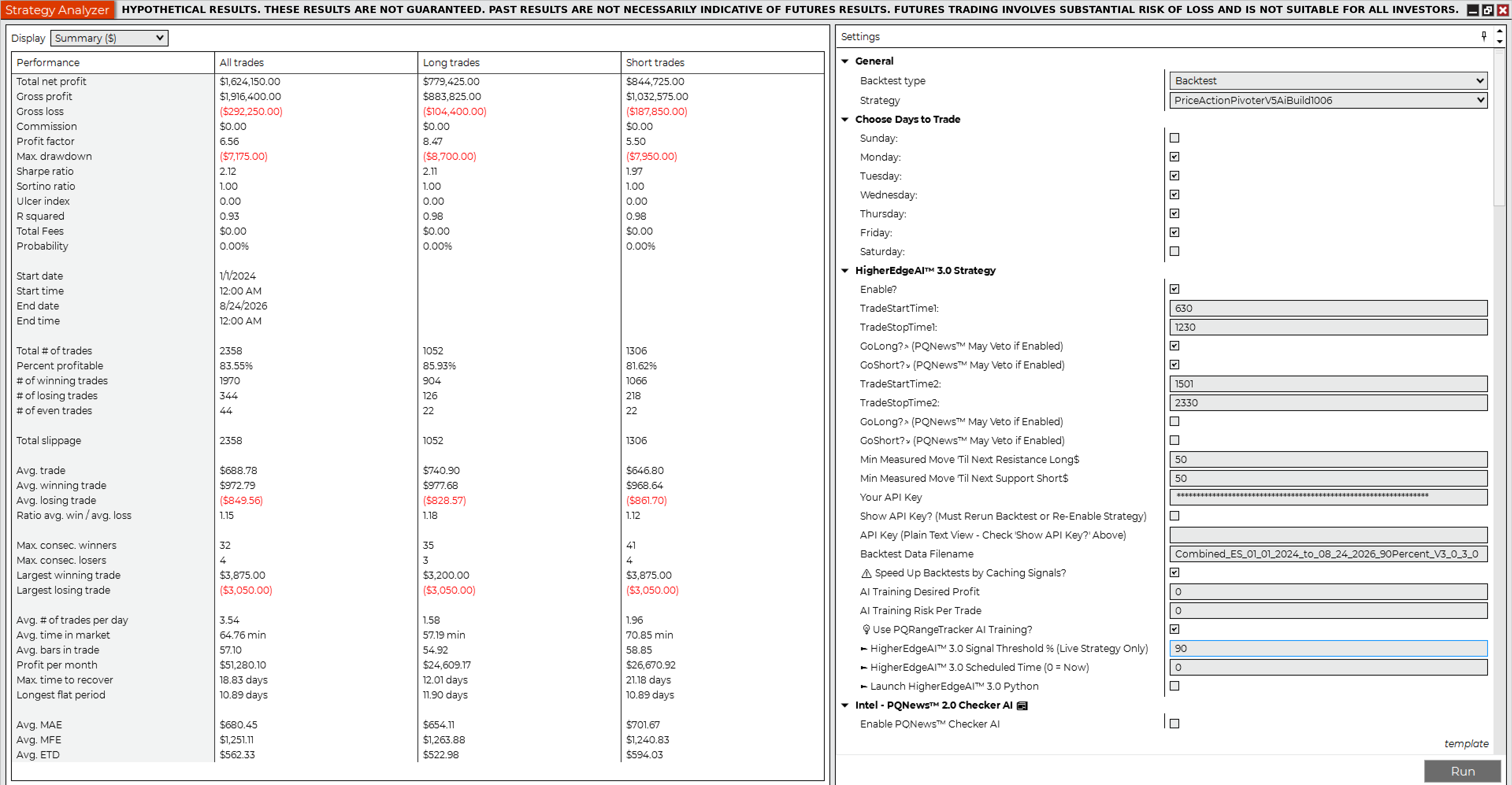
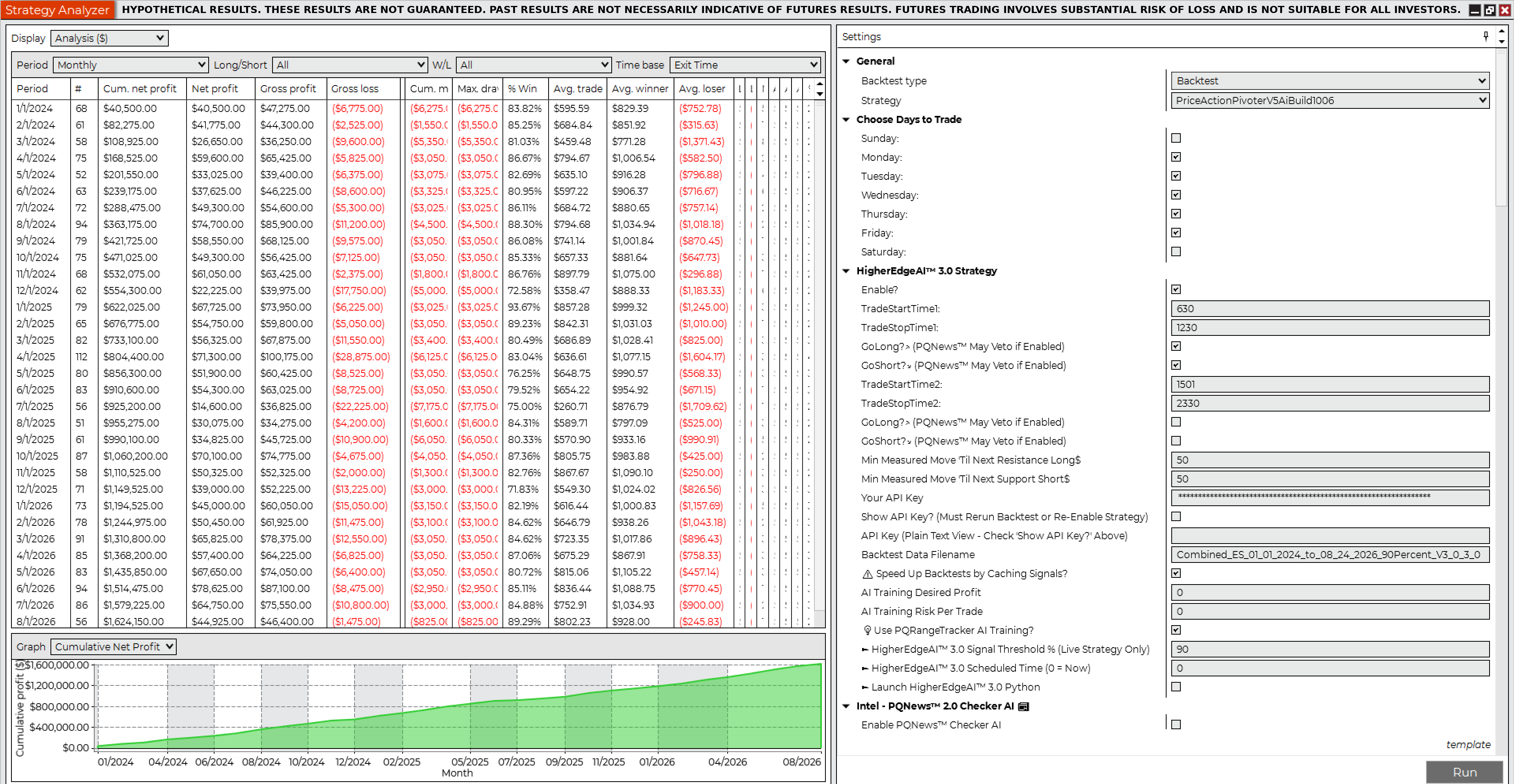
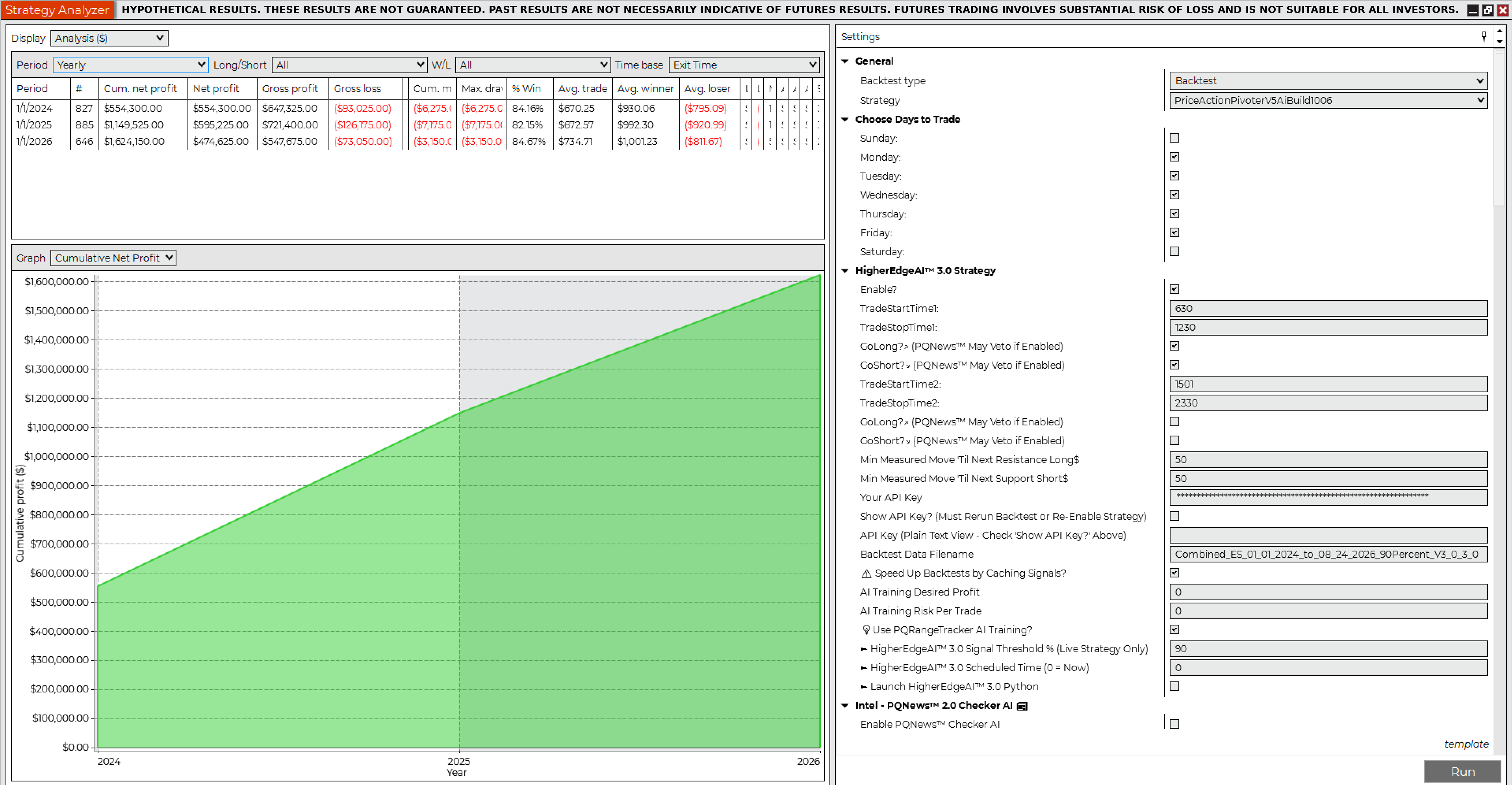
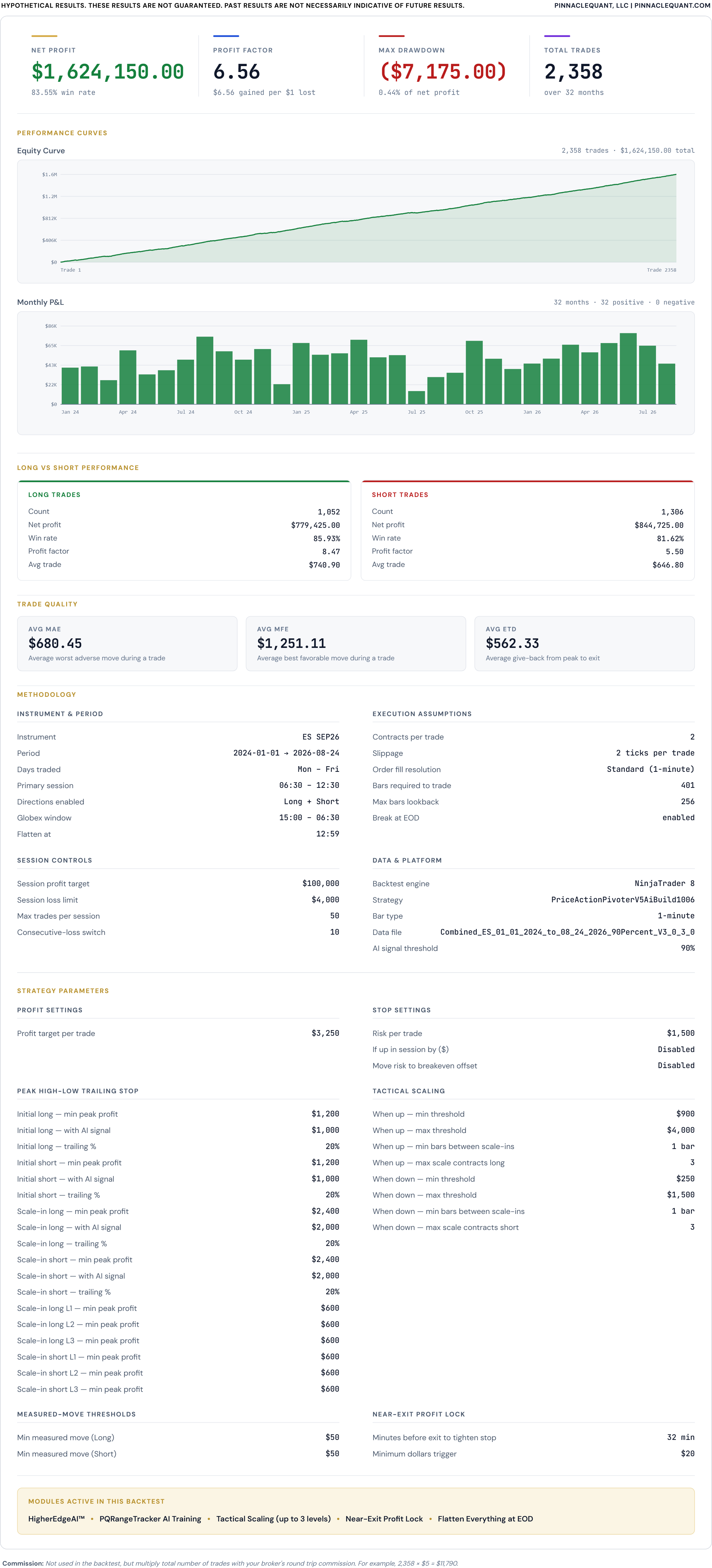
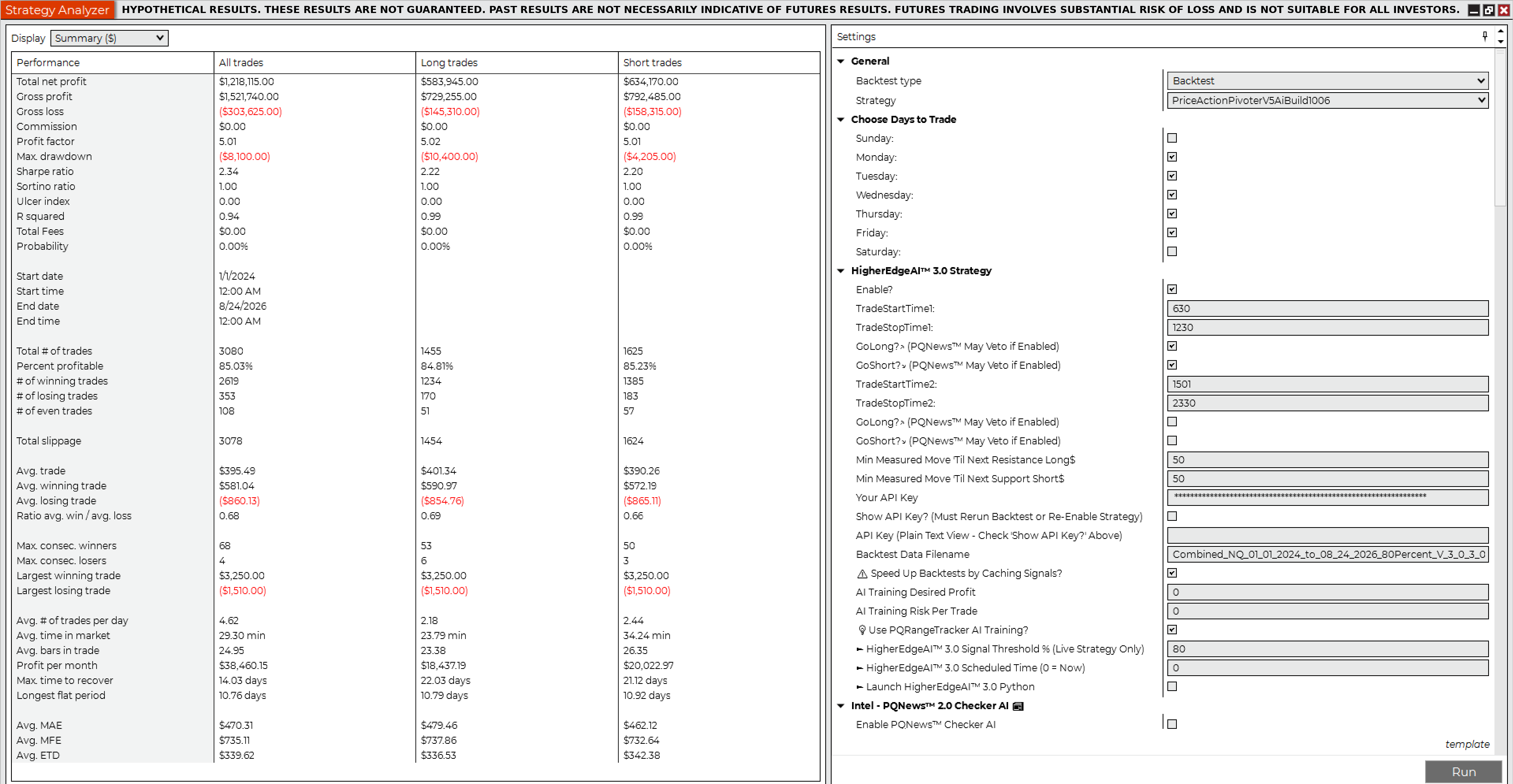
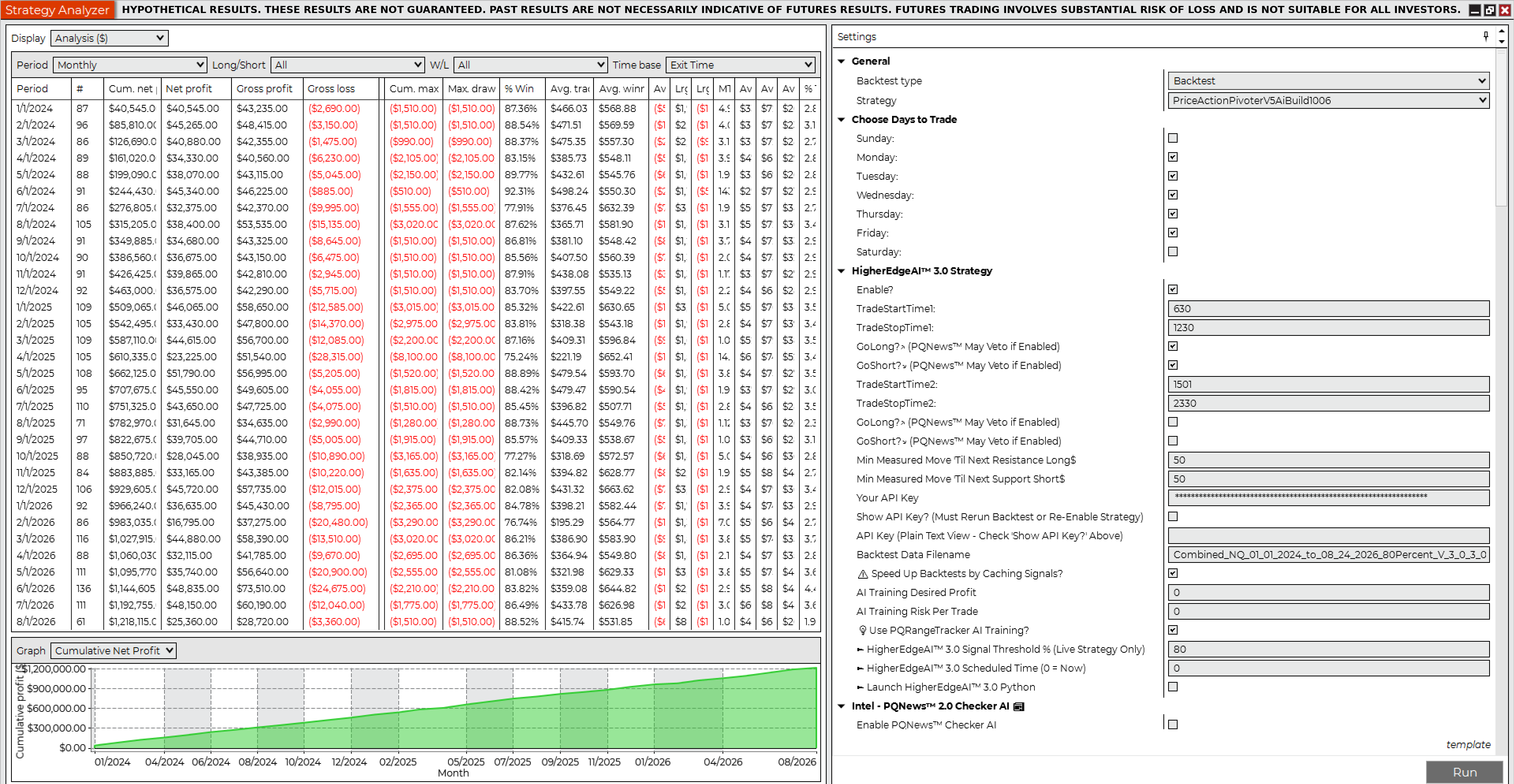
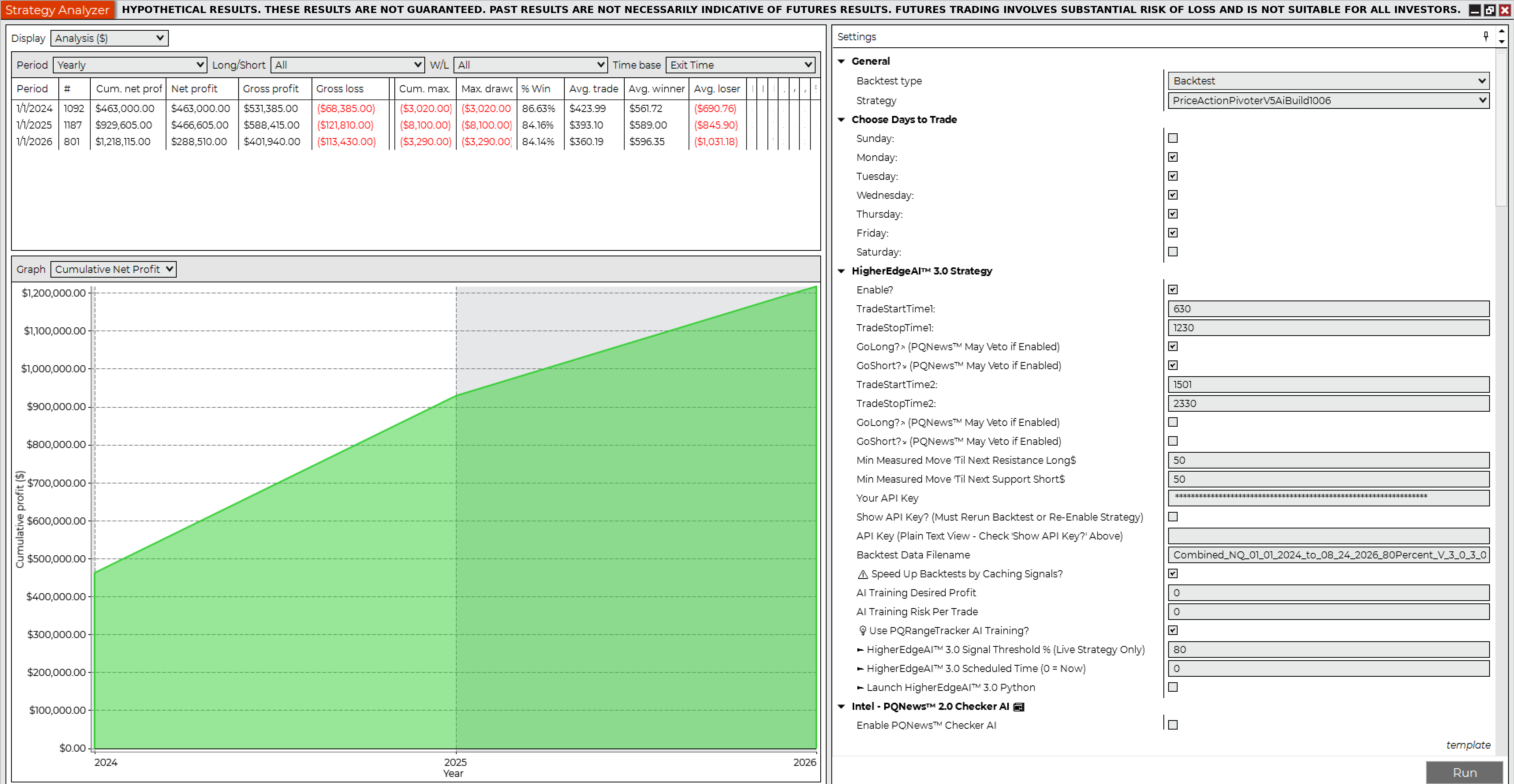
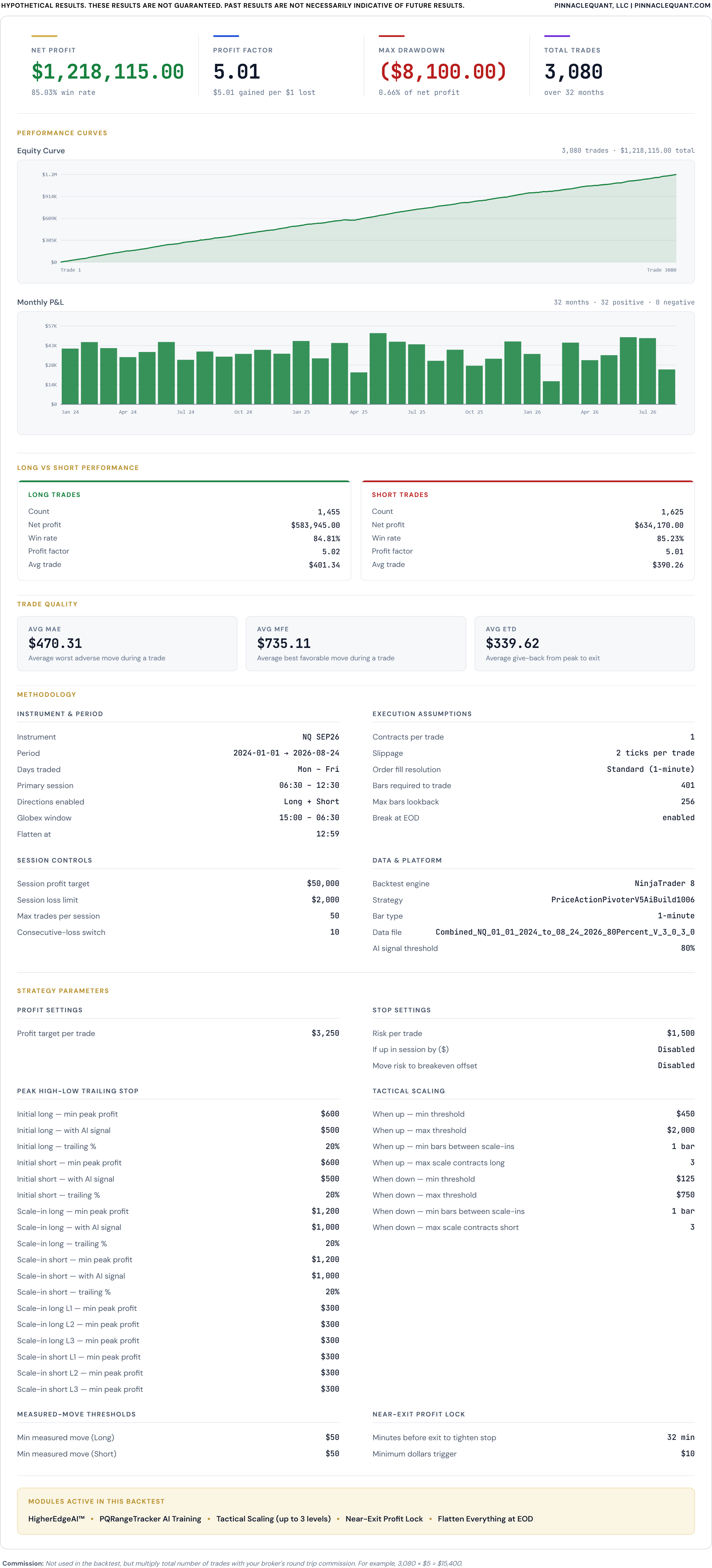
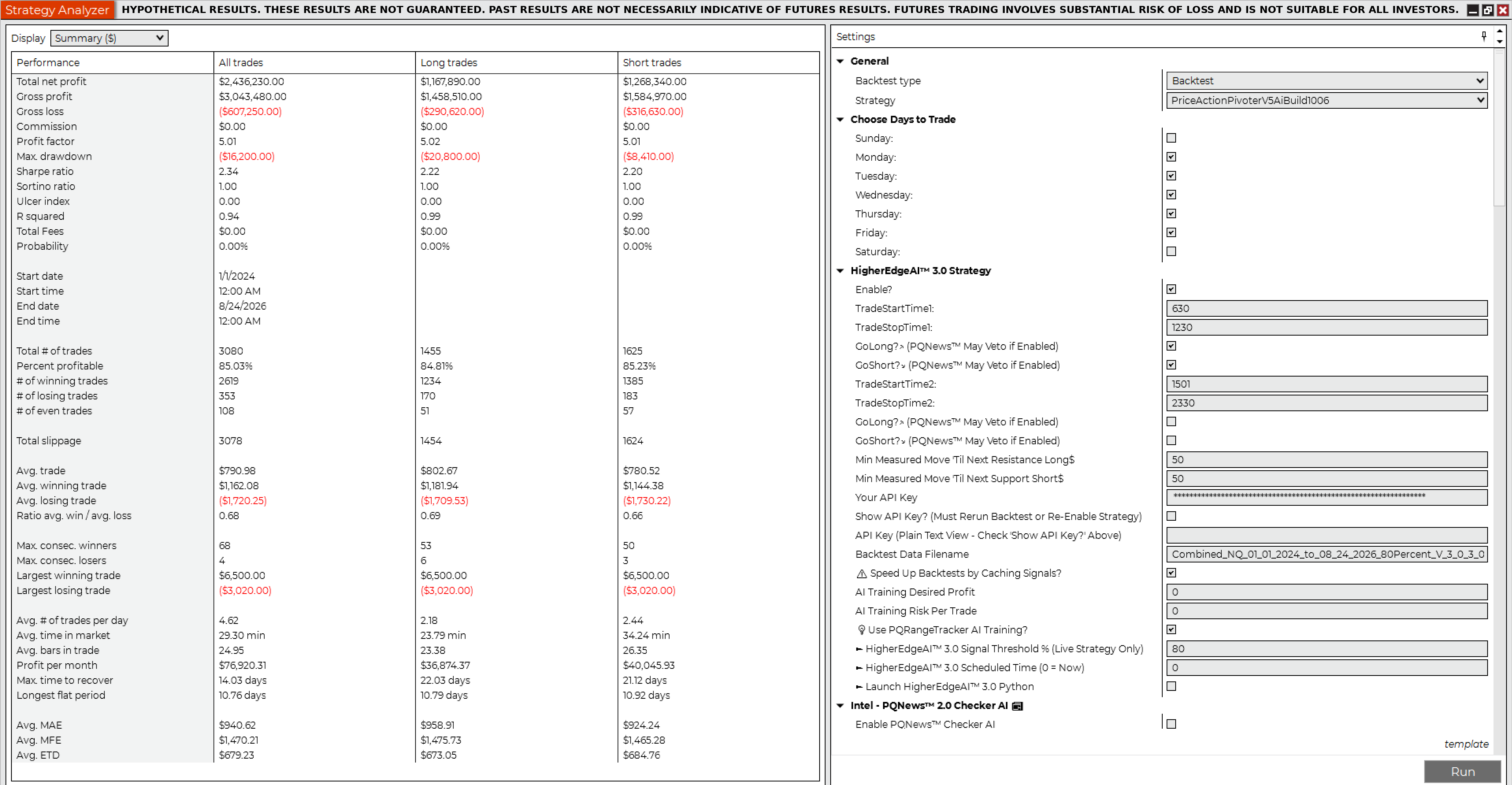
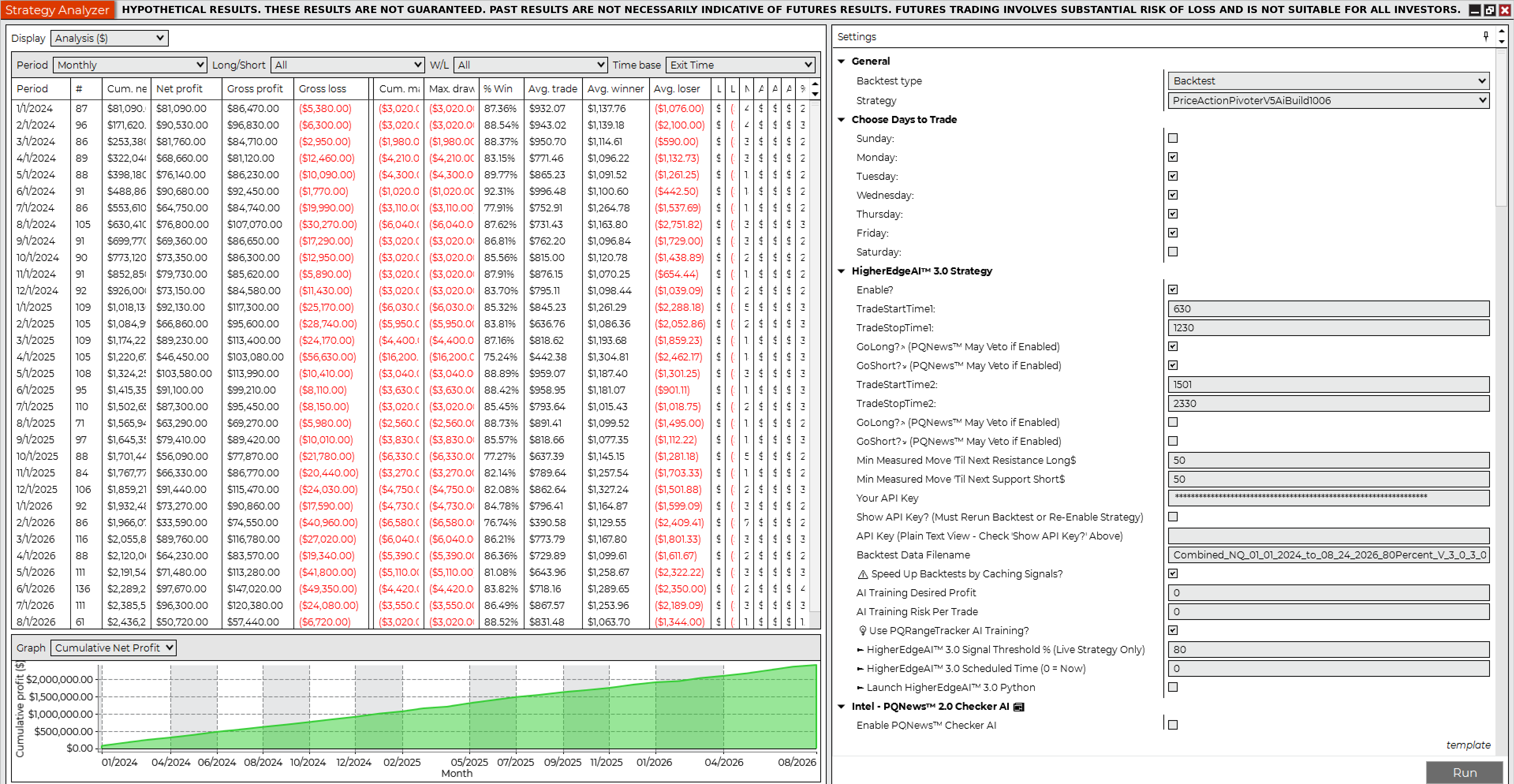
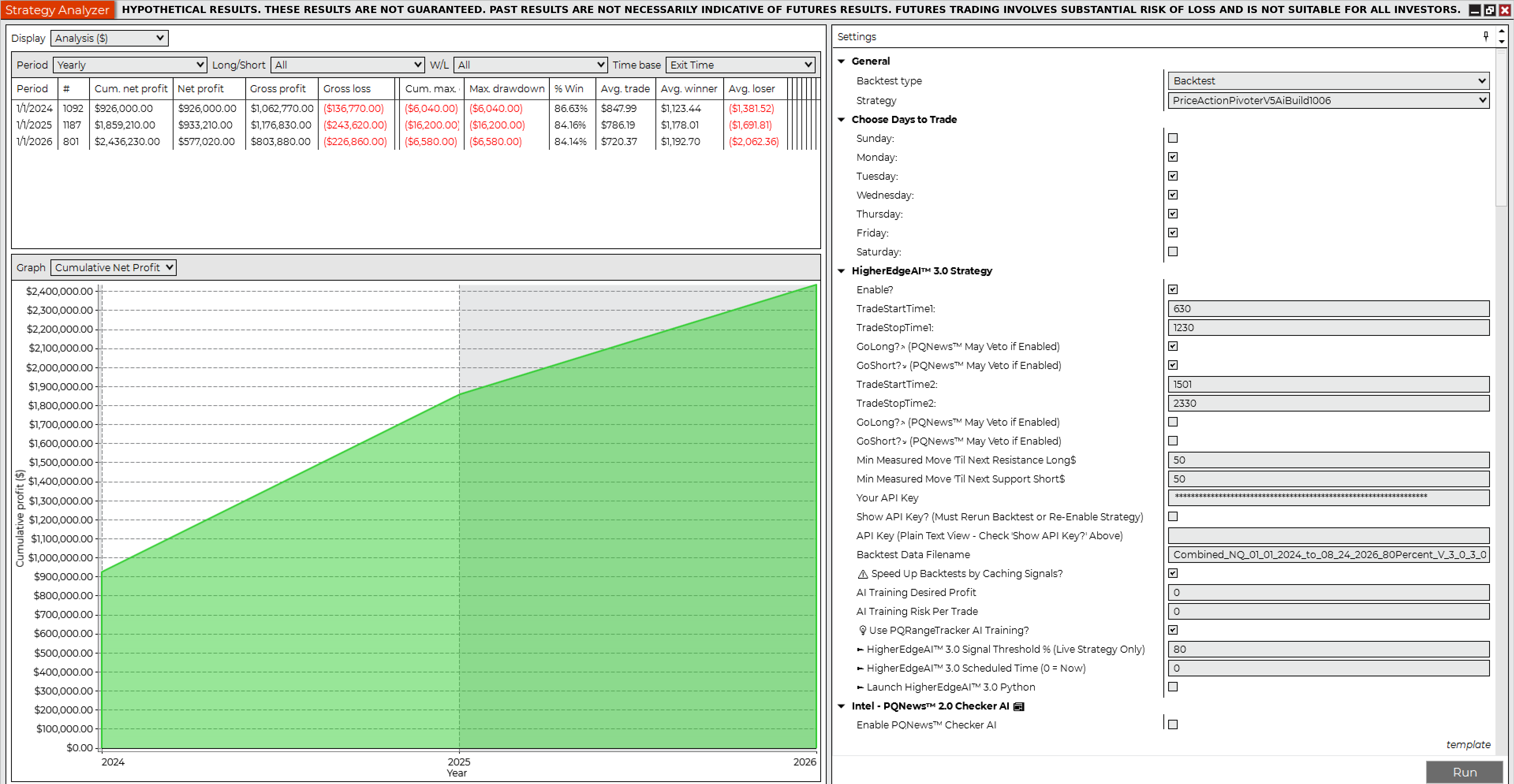
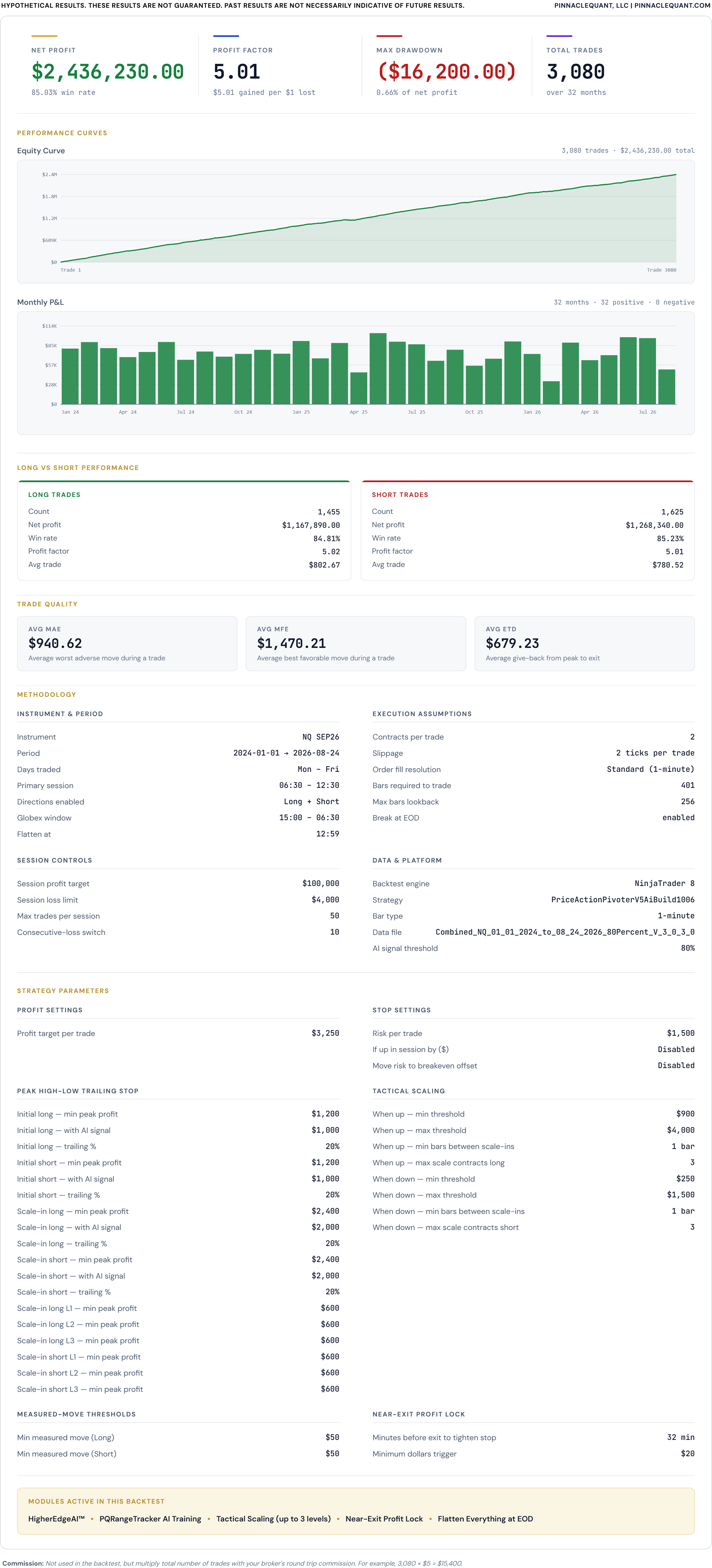
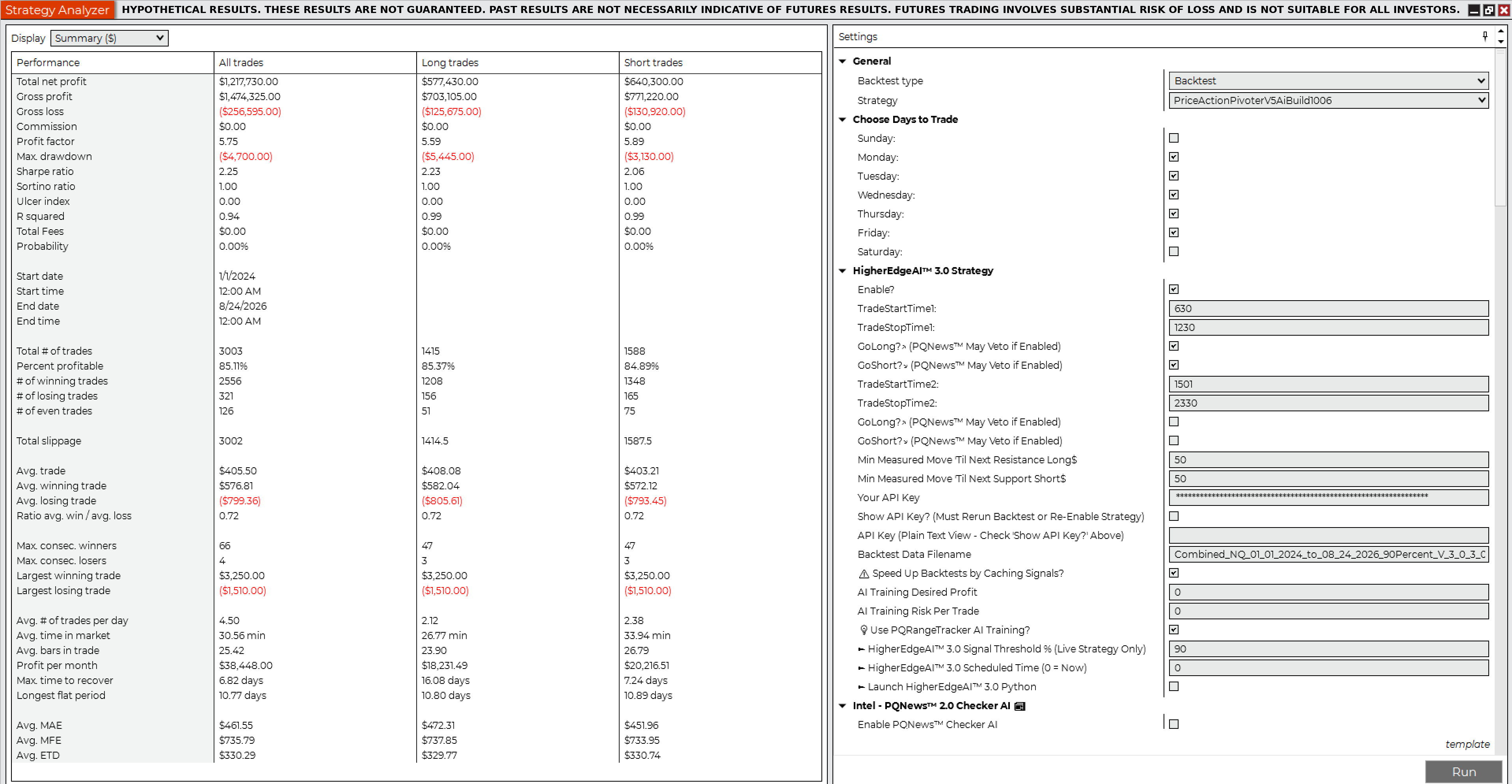
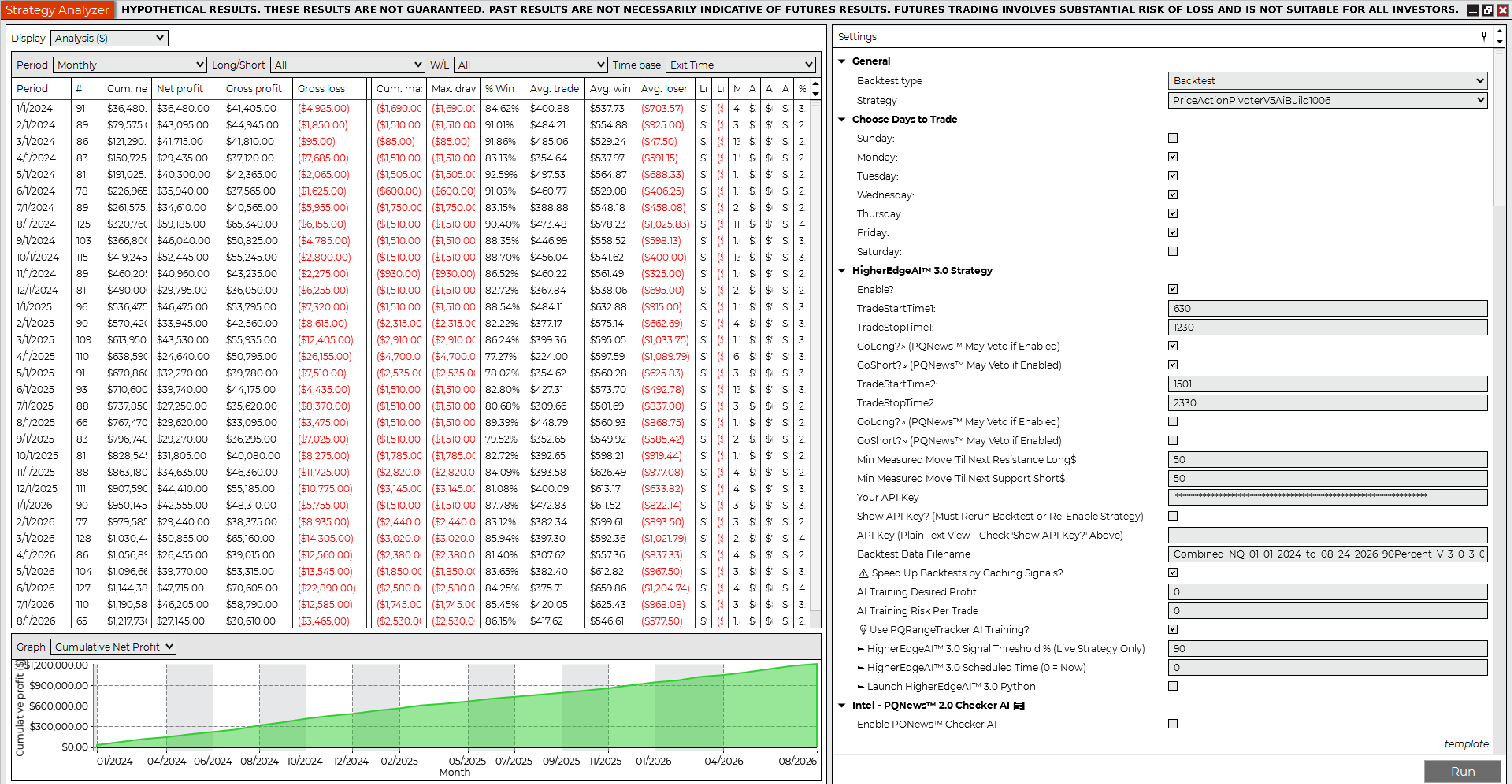
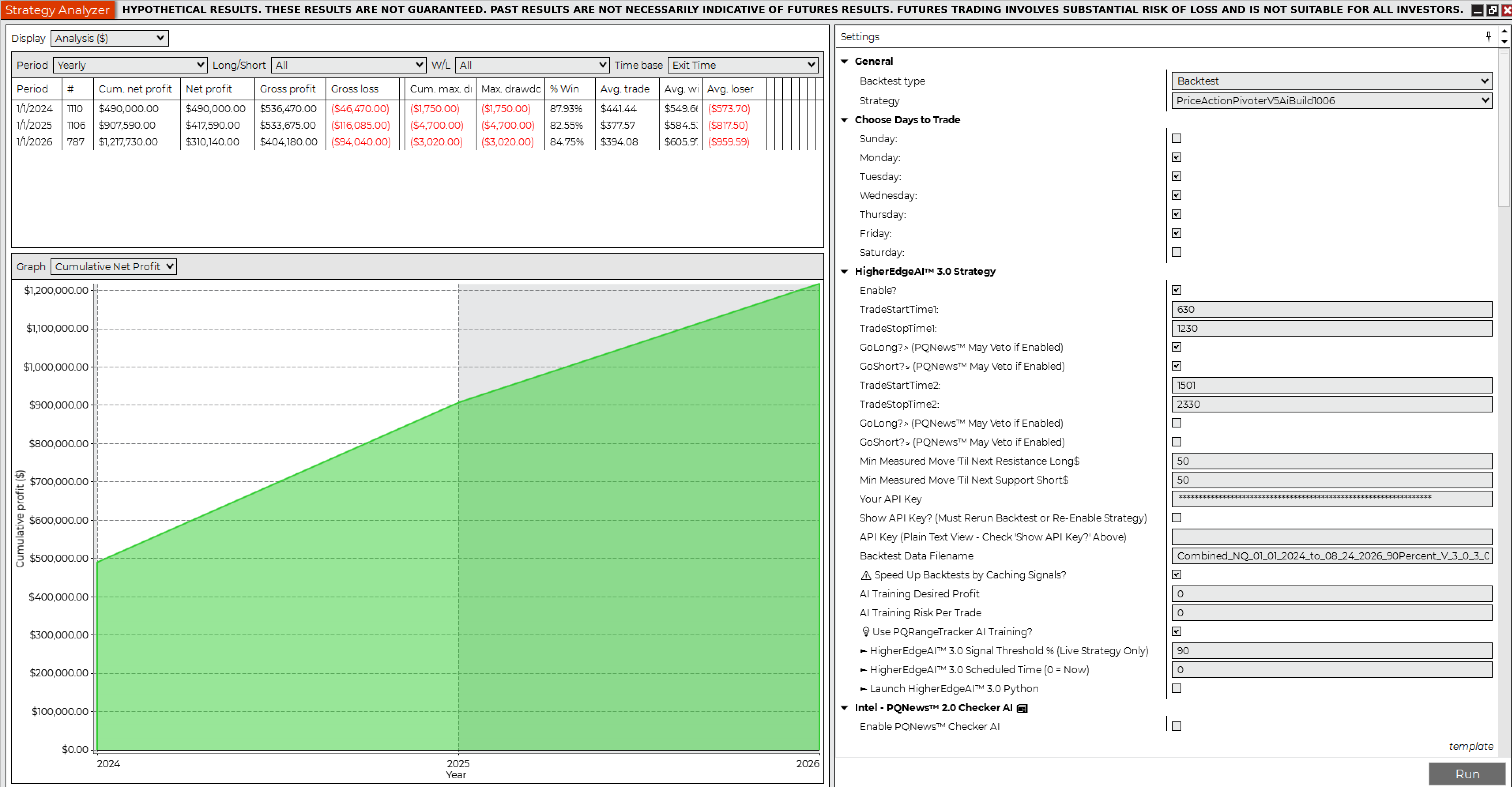
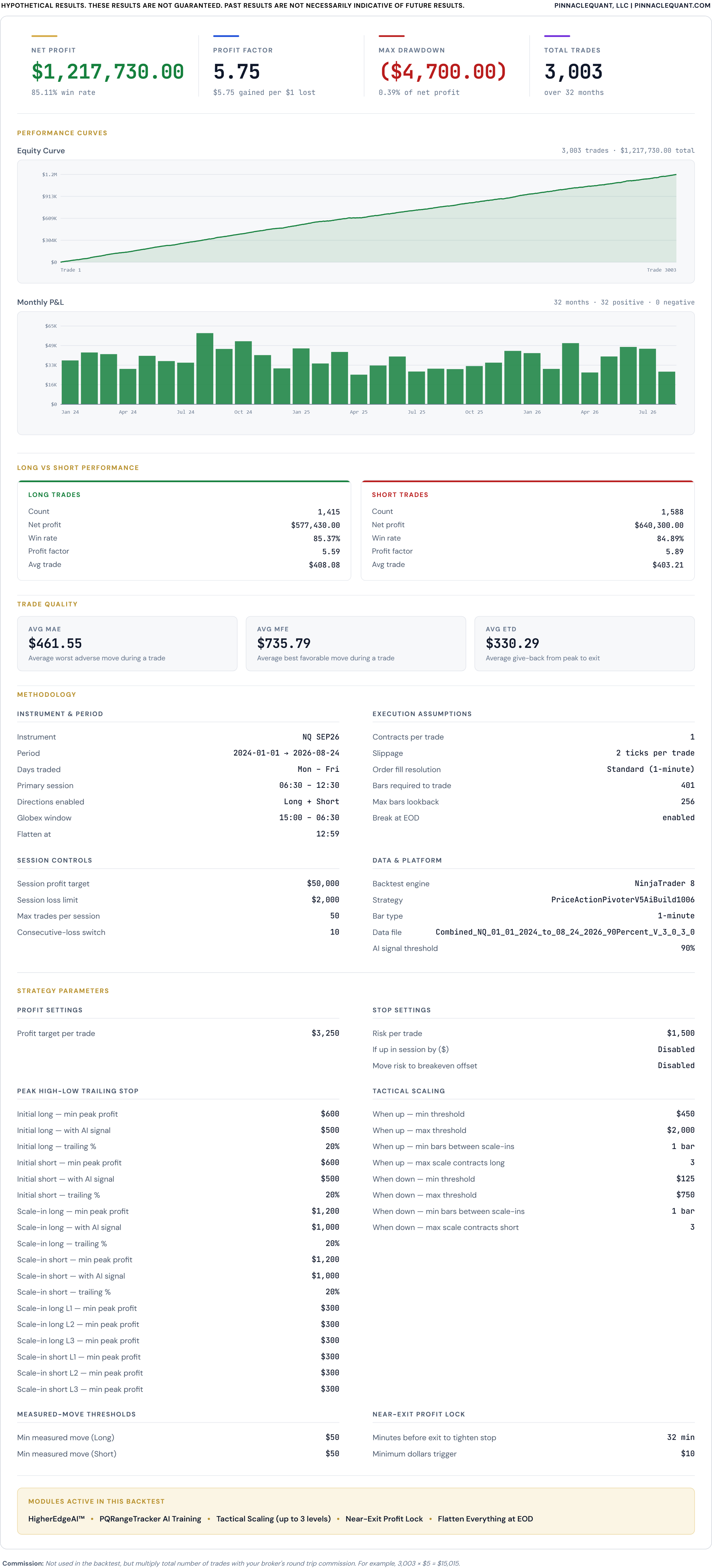
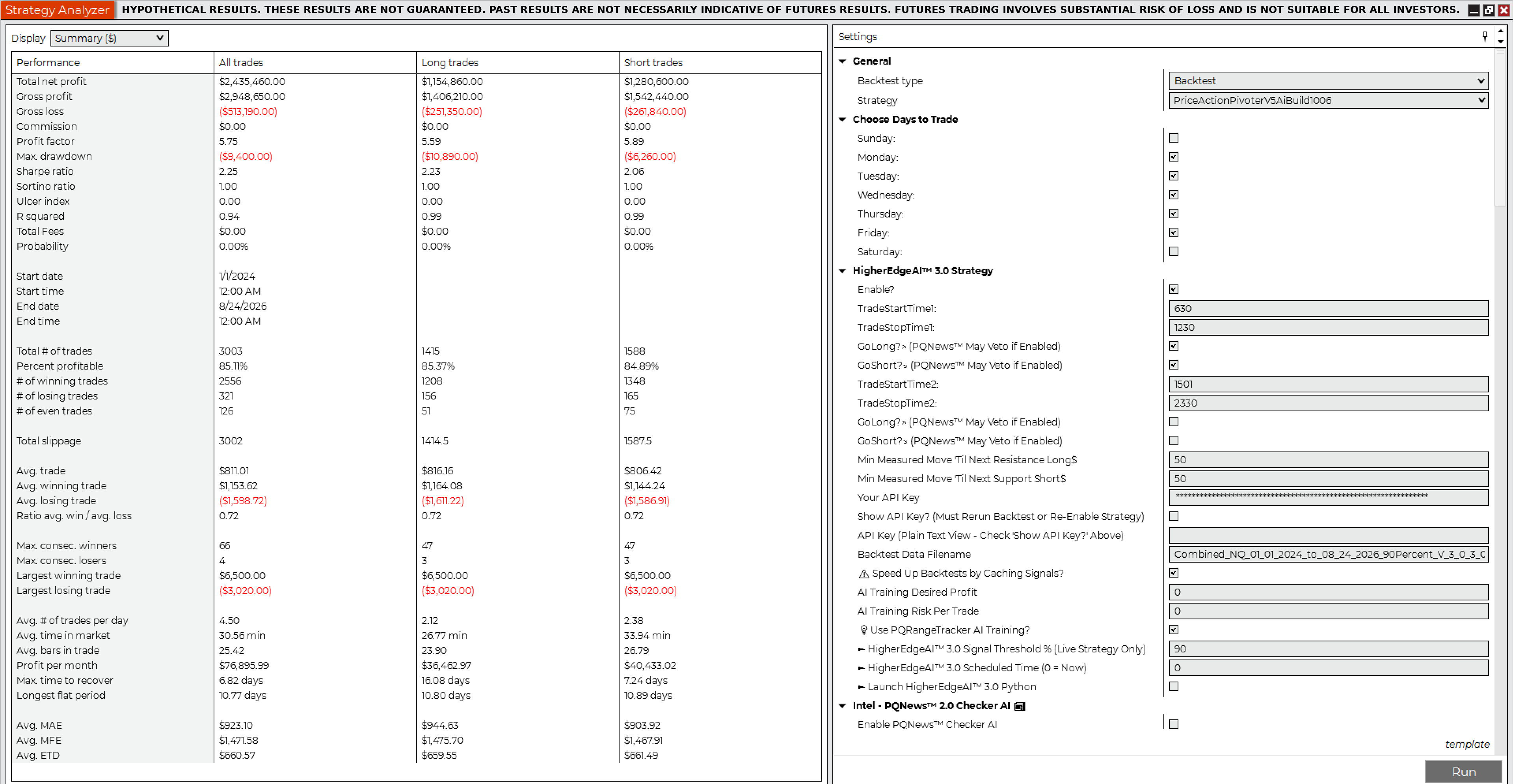
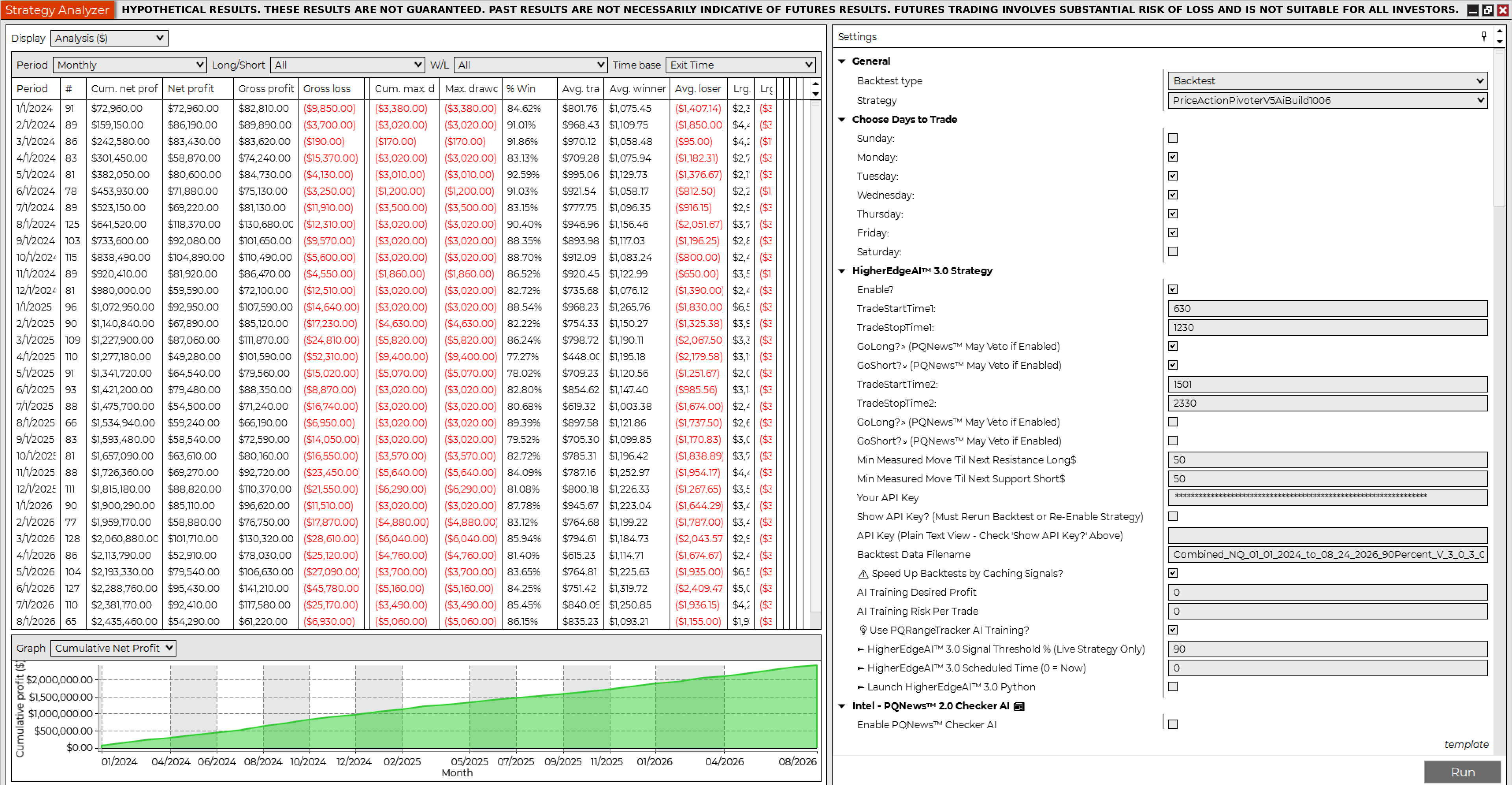
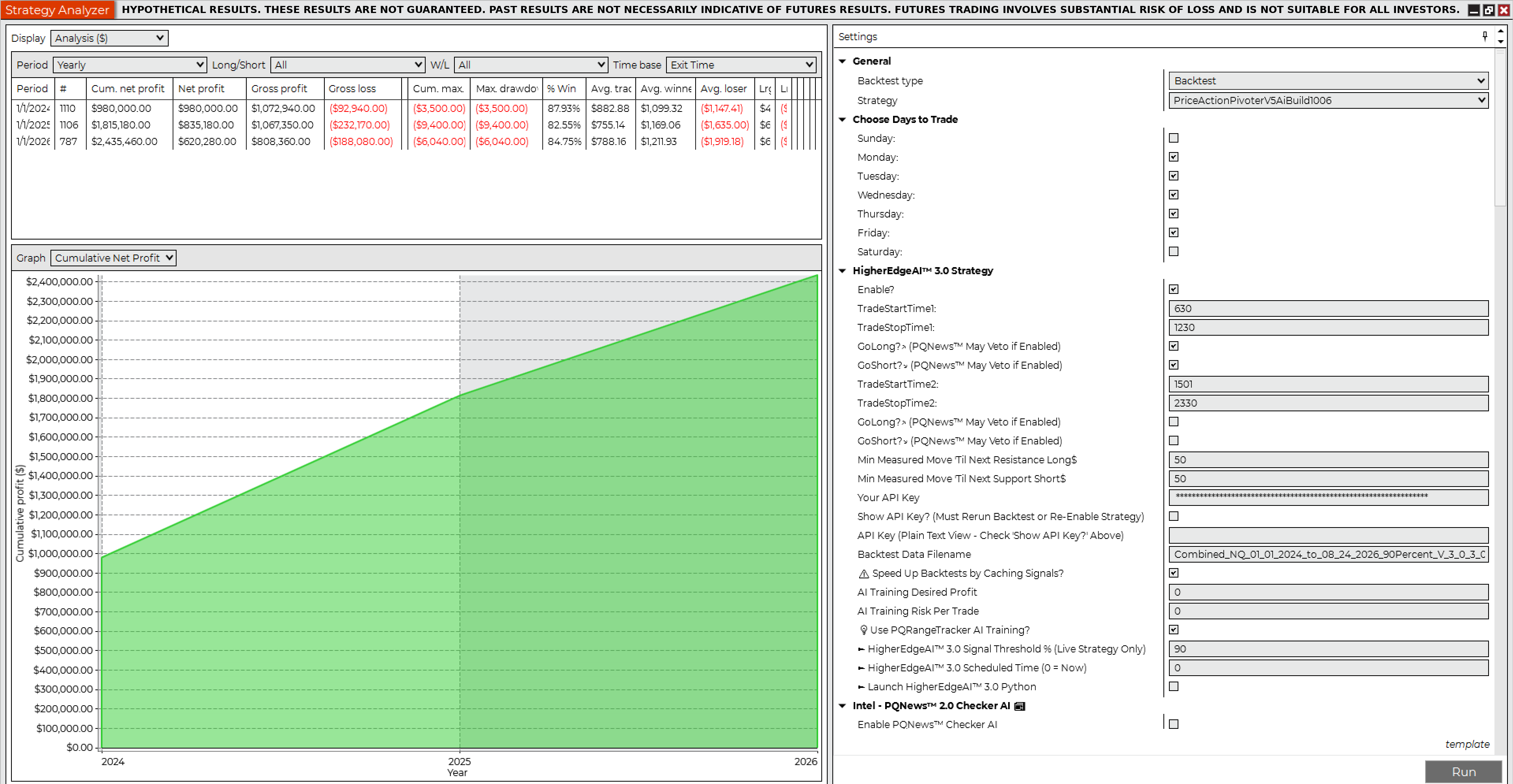
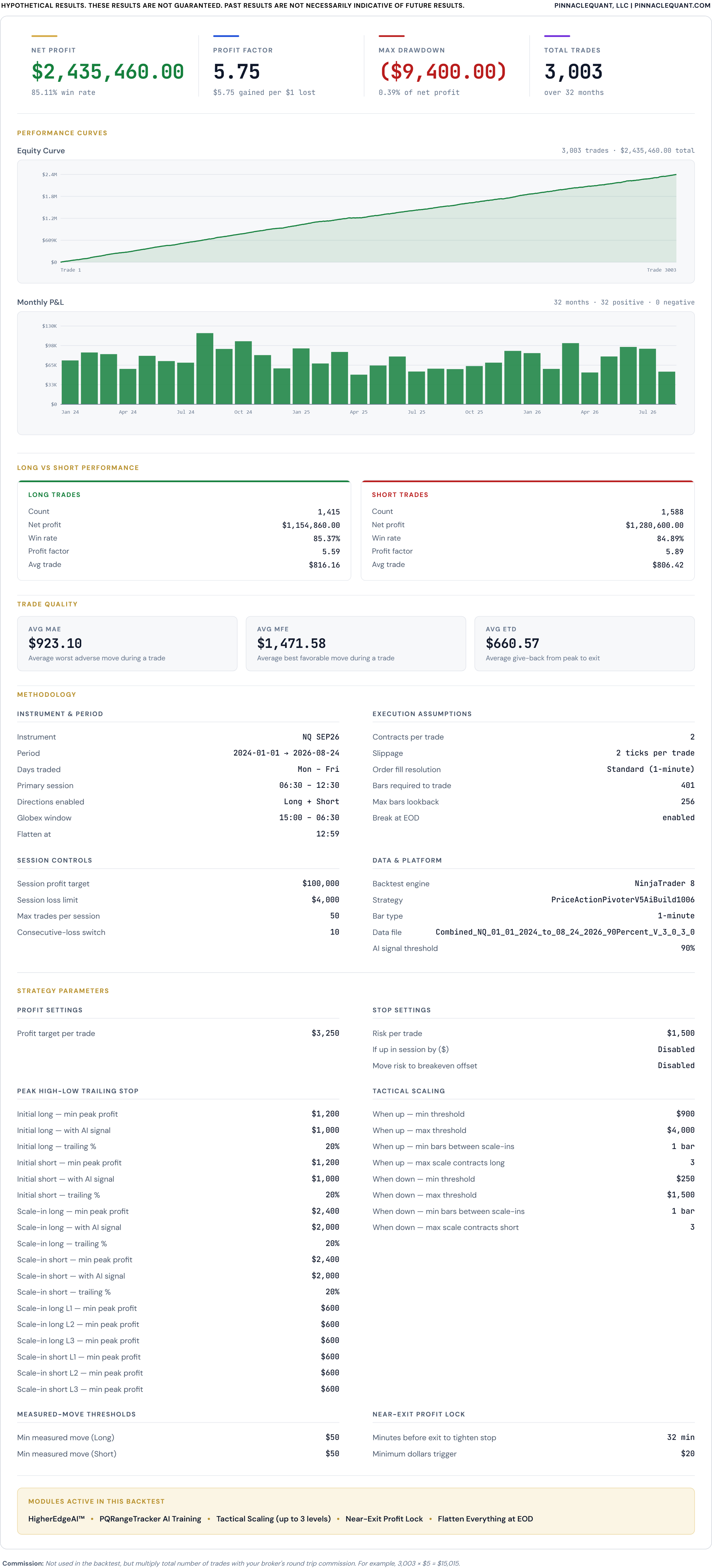
January 1, 2024 through August 24, 2026, Regular Trading Hours only, one-minute bars calculated on bar close, two ticks of slippage, commissions excluded, core parameters held constant for the entire period. HigherEdgeAI™ 3.0 training objectives were selected automatically by PinnacleQuantRangeTracker™. Every run includes the HigherEdgeAI™ signal files, a trade-by-trade file and the dashboard PDF with the exact parameters, so you can rebuild it yourself in NinjaTrader’s Strategy Analyzer. Not curve-fitted; no Renko or Heiken-Ashi bars.
While no backtest is 100% accurate and past results are not necessarily indicative of future results, the above hypothetical backtests provide valuable insights into how this machine learning automated trading system uses real-time A.I. signals to identify trades and manage them throughout their full lifecycle, with granular user control over entries, exits, and risk management.
CFTC RULE 4.41 – HYPOTHETICAL OR SIMULATED PERFORMANCE RESULTS HAVE CERTAIN LIMITATIONS. UNLIKE AN ACTUAL PERFORMANCE RECORD, SIMULATED RESULTS DO NOT REPRESENT ACTUAL TRADING. ALSO, SINCE THE TRADES HAVE NOT BEEN EXECUTED, THE RESULTS MAY HAVE UNDER-OR-OVER COMPENSATED FOR THE IMPACT, IF ANY, OF CERTAIN MARKET FACTORS, SUCH AS LACK OF LIQUIDITY. SIMULATED TRADING PROGRAMS IN GENERAL ARE ALSO SUBJECT TO THE FACT THAT THEY ARE DESIGNED WITH THE BENEFIT OF HINDSIGHT. NO REPRESENTATION IS BEING MADE THAT ANY ACCOUNT WILL OR IS LIKELY TO ACHIEVE PROFIT OR LOSSES SIMILAR TO THOSE SHOWN.
Lifetime license
One payment, and it is yours: updates, training and support included, no renewal, no annual data bill. Need more contracts? Additional 15-contract lots are $5,000 each. The current offer date is shown under each price.
Live sessions
Recorded during live sessions on ES and NQ. You see the signals arrive, the entries, the stop management and the PQNews™ veto as they happened, with no edits.


“Wealth hastily gotten will dwindle, but those who gather little by little will increase it.” – Proverbs 13:11
Raffi was interviewed by Matthias Knab on Opalesque TV during the SALT Conference in 2019, where they discussed Raffi’s trading methodology and his work at the time as an E-mini S&P 500 (ES) specialist serving hedge fund portfolio managers. The interview pre-dates Pinnacle Quant’s retail focus, but the institutional foundation it reflects is what grounds every automated trading system Raffi has built since.


Request a Zoom Demo to See the Machine Learning & Gemini News-Powered Price Action Pivoter™ Trading Suite Live!

“Discover for yourself if this unique automated trading suite is a good fit for the results you are accountable to deliver.”
Bloomberg® and Bloomberg Terminal® are registered trademarks of Bloomberg Finance L.P. Pinnacle Quant, LLC is not affiliated with, endorsed by, or sponsored by Bloomberg L.P. or any of its affiliates. Bloomberg Terminal pricing shown on this page is the published 2026 single-seat list price and add-on ranges as reported by multiple industry sources; Bloomberg L.P. does not publish a public price list and actual contract terms vary. NinjaTrader® is a registered trademark of NinjaTrader, LLC. Interactive Brokers® is a registered trademark of Interactive Brokers LLC. Google Gemini is a trademark of Google LLC. All other trademarks are the property of their respective owners.
Price Action Pivoter™, HigherEdgeAI™, PQNews™ and PinnacleQuantRangeTracker™ are trademarks of Pinnacle Quant, LLC. Licensees remain solely responsible for their own registration, disclosure, suitability and trade-allocation obligations under CFTC, NFA, SEC and state rules.